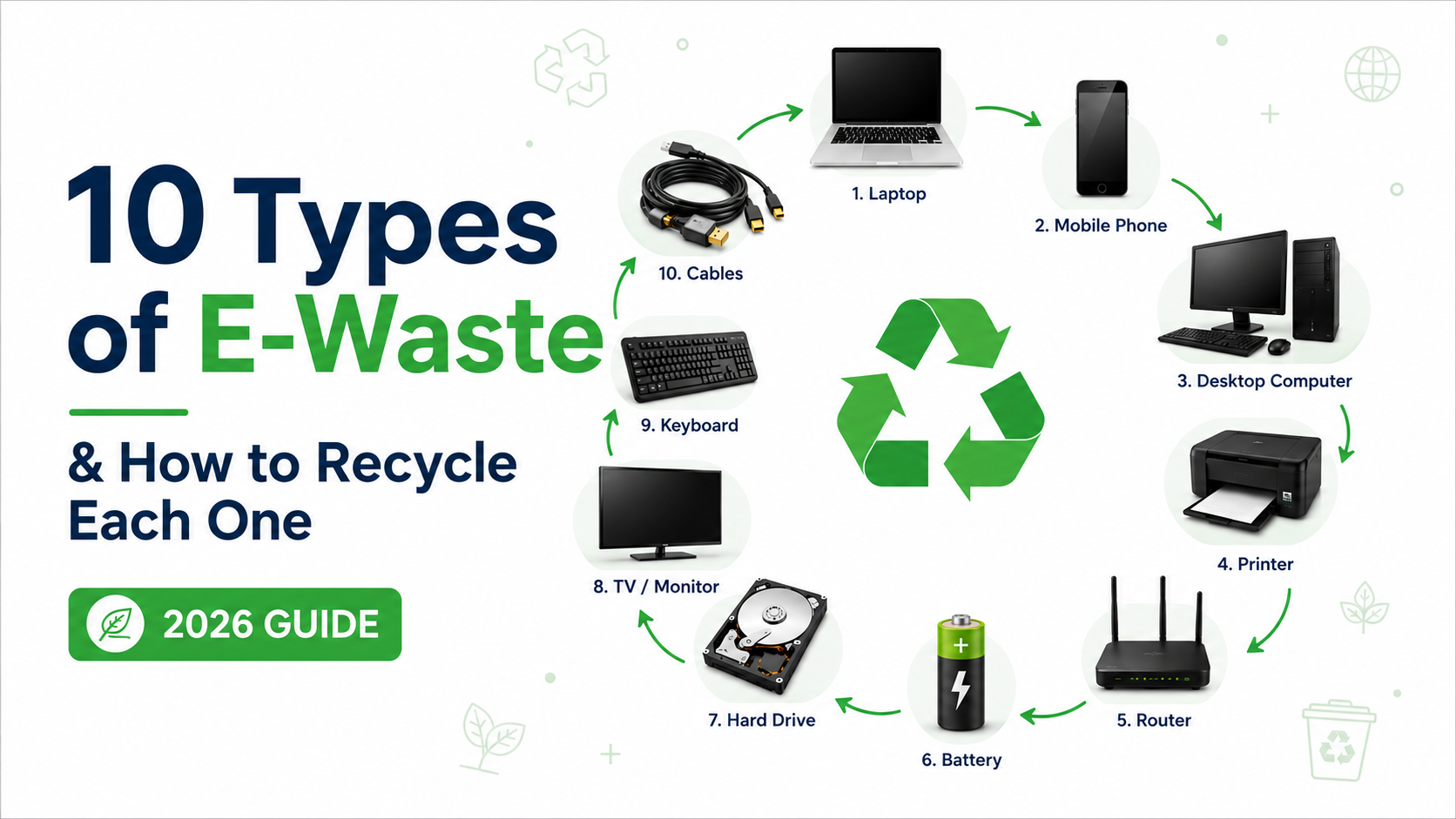
Think about the devices you have replaced in the past five years. A phone or two. Maybe a laptop. Possibly a router, a set of earbuds, a broken blender, a dead power bank. Each of those went somewhere and in much of the world, that somewhere is still a general waste bin or a landfill.
E-waste is now the fastest-growing solid waste stream globally, with the Global E-waste Monitor recording 62 million metric tonnes generated in 2023. Of that, less than a quarter was formally collected and processed through authorised channels. The rest ended up in places it was never designed to go.
The term ‘e-waste’ covers far more ground than most people realise. It is not just phones and computers. It spans medical equipment, lighting, solar panels, children’s toys, kitchen appliances, and industrial machinery. If a product uses electricity or contains a battery, it qualifies.
This guide breaks down all ten major e-waste categories, what they contain, why they need specialist handling, and how businesses and individuals across the UAE, GCC, and beyond can dispose of them through proper channels.
What Is E-Waste?
E-waste, short for electronic waste refers to any discarded product that runs on electricity or contains a battery. The international framework for managing it is known as WEEE: Waste Electrical and Electronic Equipment.
The WEEE definition is intentionally broad. A refrigerator qualifies. So does a hearing aid, a solar inverter, a cordless drill, and a smart thermostat. What they share is that they cannot be responsibly processed alongside general household waste — they contain materials that require specialist handling.
Some of those materials are valuable: gold, silver, copper, cobalt, and rare earth elements. Others are hazardous: lead, mercury, cadmium, and brominated compounds. Proper recycling channels are designed to recover the former and safely contain the latter.
| E-Waste in Numbers (Global E-waste Monitor 2024) 62 million metric tonnes generated globally in 2023 22.3% formally collected and recycled 60+ elements from the periodic table found in e-waste Recoverable material value estimated at $91 billion USD annually UAE generates an estimated 250,000+ tonnes per year GCC e-waste market projected to reach $1.5 billion by 2027 |
Why E-Waste Needs Separate Handling
The short answer: the materials inside electronic devices do not belong in landfill. Some degrade slowly and migrate into soil and water. Others require specific industrial processes to be safely neutralised or recovered.
Beyond the environmental side, businesses have practical reasons to take disposal seriously. WEEE regulations exist in the UAE (Federal Law No. 12 of 2018), Saudi Arabia, across Europe (WEEE Directive 2012/19/EU), and in various US state-level frameworks. These rules place disposal obligations on producers, importers, and in some jurisdictions, large-volume business users.
Data security is another consideration specific to IT equipment. A device that goes to landfill without data erasure can carry recoverable business or personal information — something that matters regardless of what waste legislation says about it.
The 10 Main E-Waste Categories at a Glance
| Category | Common Devices | Notable Materials | Recovery Potential |
| ICT & Telecoms | Phones, laptops, servers, routers | Gold, lead, cadmium, cobalt | High |
| Large Appliances | Fridges, washers, ACs, ovens | Steel, copper, refrigerants | High |
| Small Appliances | Toasters, kettles, vacuum cleaners | Mixed metals, heating elements | Medium |
| Consumer AV Electronics | TVs, speakers, cameras, consoles | Copper, rare earths, lead solder | Medium–High |
| Lighting | LED bulbs, fluorescent tubes | Indium, gallium, mercury | Medium |
| Power Tools & Industrial | Drills, generators, UPS systems | Copper windings, steel, batteries | Medium–High |
| Medical Equipment | Monitors, ventilators, imaging devices | Gold, silver, platinum contacts | High |
| Solar & Energy Systems | PV panels, inverters, BESS | Silicon, aluminium, silver, glass | High |
| Batteries & Cables | Li-ion packs, lead-acid, chargers | Lithium, cobalt, lead, copper | High |
| Toys, Wearables & e-Mobility | E-scooters, smartwatches, drones | Lithium cells, circuit boards | Medium |
1. ICT Equipment and Telecommunications Devices
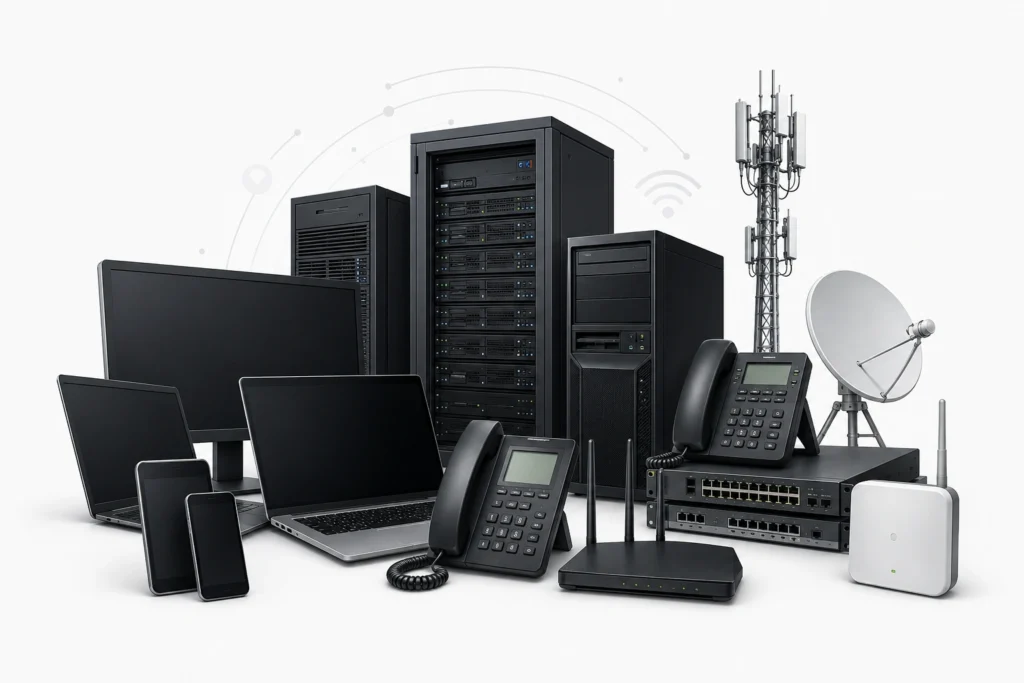
This is the category that most people picture when they hear ‘e-waste’ — and it generates enormous volumes. Global smartphone shipments exceeded 1.2 billion units in 2023, and the average replacement cycle sits at around 2.5 years. Add laptops, tablets, desktop computers, servers, routers, switches, printers, and photocopiers, and you have the single most discussed waste stream in the electronics industry.
Circuit boards inside ICT devices are dense with recoverable metals. A tonne of circuit boards contains more gold than a tonne of gold ore, often by a significant margin. That same tonne also contains lead-based solders, cadmium in older nickel-cadmium batteries, beryllium in connectors, and brominated flame retardants in the board substrate itself.
Data Before Everything Else
What sets ICT equipment apart from every other e-waste category is the data question. A laptop that goes through a standard factory reset still has recoverable data on its drive. Phones, servers, and network equipment are no different. For any business retiring IT assets, the disposal process needs to start with certified data erasure — DoD 5220.22-M or NIST 800-88 wiping protocols, or physical destruction of the storage media — before the device moves anywhere.
A reputable ITAD (IT Asset Disposition) provider will document this step and issue a certificate of data destruction. That documentation matters if questions arise later.
2. Large Household and Commercial Appliances
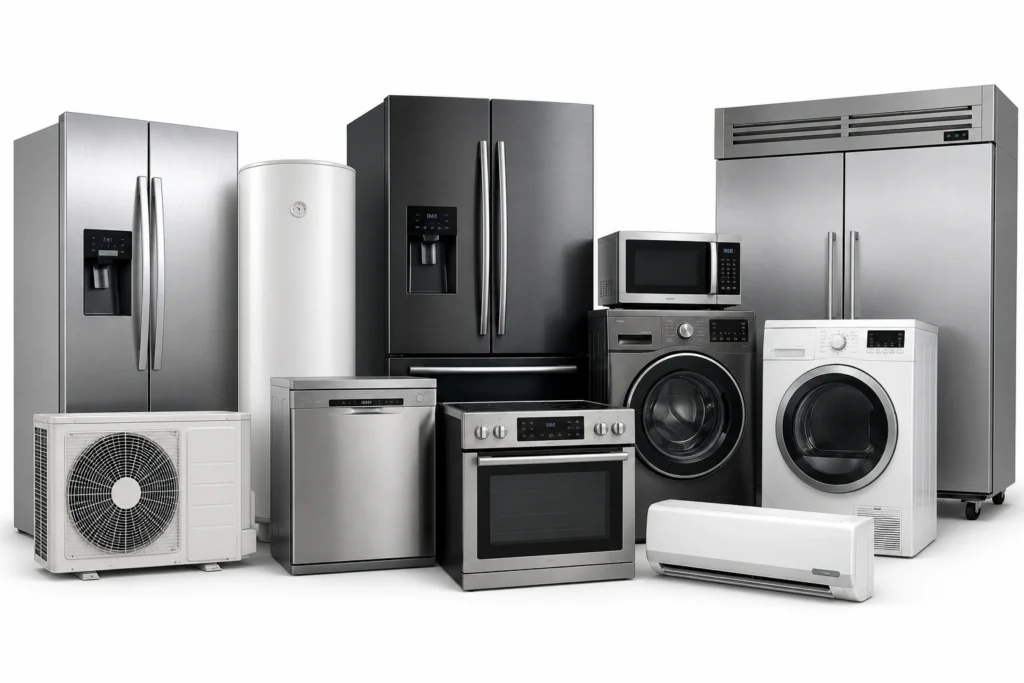
Refrigerators, washing machines, dishwashers, electric ovens, air conditioners, and heat pumps are the heavyweight end of the e-waste spectrum — literally. A standard refrigerator can weigh 80–100 kg. Much of that weight is recyclable steel, copper, and aluminium, but large appliances also contain refrigerant gases (HFCs and HCFCs) that need to be captured before any dismantlement begins.
Venting refrigerant gases into the atmosphere is prohibited under both UAE regulations and international climate agreements. Certified recyclers use specialist equipment to capture and contain refrigerants before processing begins. This is one of the clearest reasons why large appliance disposal through unregistered channels creates problems that go beyond the device itself.
What Happens to the Materials
After refrigerant recovery, the steel shell goes to a metal shredder and is magnetically separated for smelting. Copper motor windings are stripped and sold to copper smelters. Compressor oil is drained and processed separately. Plastic components are granulated and either downcycled or used as industrial feedstock. Very little of a properly processed refrigerator needs to go to landfill.
3. Small Household Appliances and Kitchen Gadgets
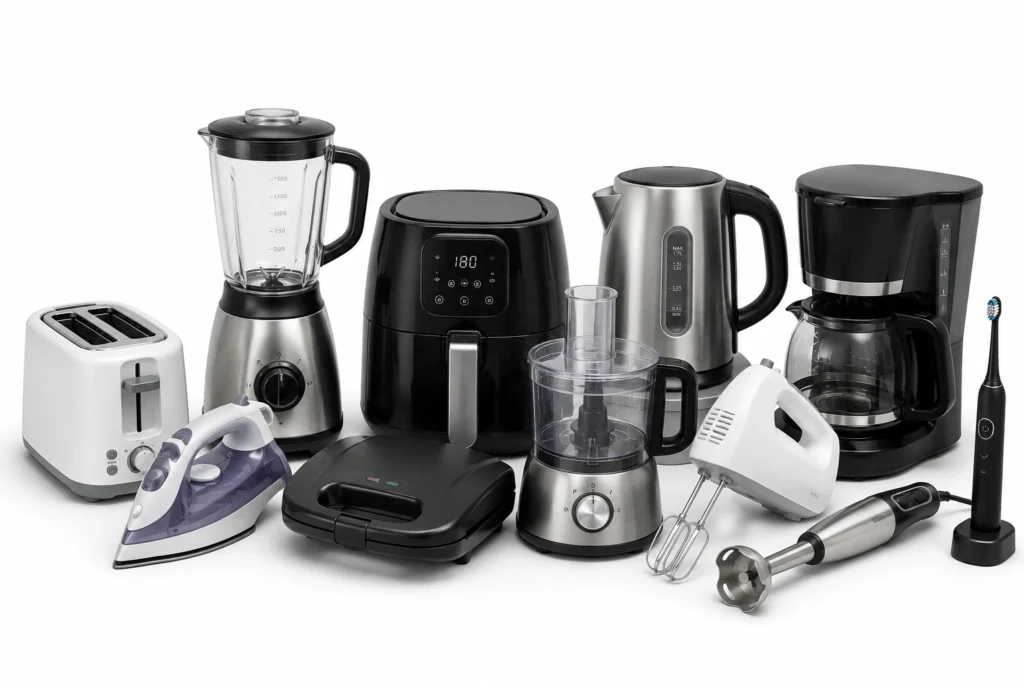
The small appliance market has grown quickly in recent years, and disposal habits have not kept pace. Millions of blenders, coffee machines, air fryers, electric kettles, food processors, and stand mixers reach end-of-life each year, with the majority ending up in general waste.
Individually these devices are less complex than laptops or refrigerators, but they still contain wiring harnesses, heating elements, small motors, capacitors, and in many cases rechargeable battery cells. The cumulative volume of small appliance waste is significant.
- Kettles and toasters: nichrome heating wire, stainless steel, thermostats
- Vacuum cleaners: motors, carbon brushes, HEPA filter casings
- Food processors: hardened steel blades, polycarbonate housings, motor assemblies
- Coffee machines: aluminium boilers, silicon tubing, pressure pumps
Most small appliances can be dropped off at designated collection points, retailer take-back schemes, or included in bulk commercial collections. They do not need to go in the bin.
4. Consumer Electronics: Audio, Video, and Cameras
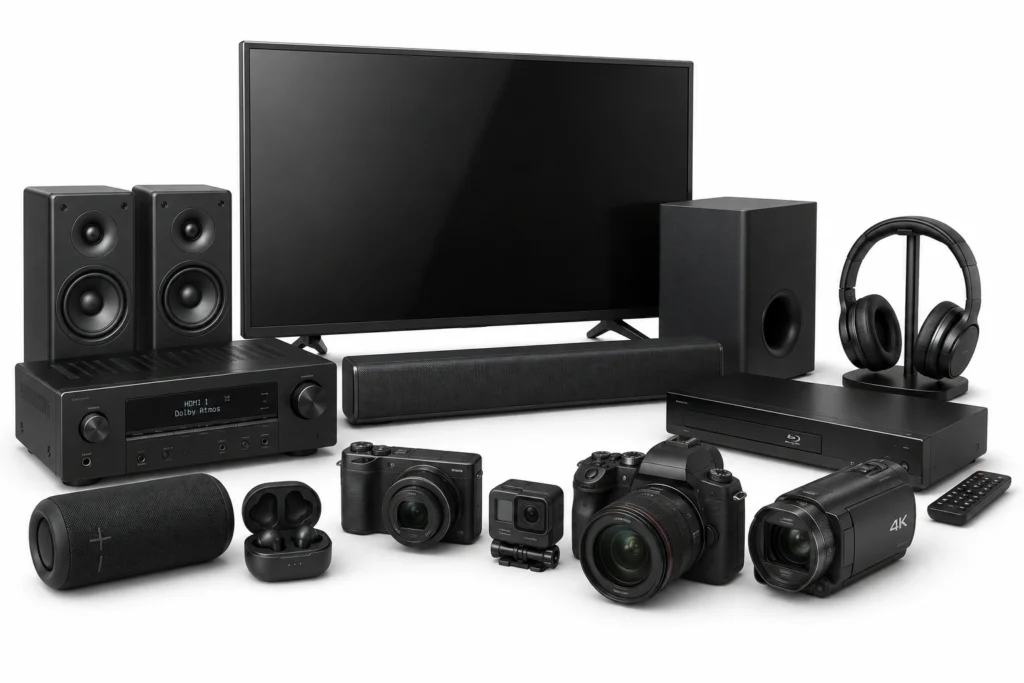
Televisions, home cinema systems, portable speakers, digital cameras, gaming consoles, streaming devices, and DVD players all fall into this category. The material profile has shifted considerably over the past decade as CRT televisions gave way to flat-screen displays.
Older CRT screens contained significant quantities of lead glass — sometimes 2–8 kg per unit — which requires specialist processing. Modern LCD and OLED screens present different challenges: indium-tin oxide coatings, rare earth phosphors in LED backlighting, and fragile panel structures that need careful handling to avoid material loss.
| Component | Material | Recovery Notes |
| CRT screen | Lead glass | Requires specialist lead-glass processing |
| LCD panel | Indium-tin oxide, phosphors | Indium is critically scarce — high recovery value |
| Speaker magnets | Neodymium | Rare earth — used in EV motors and wind turbines |
| Circuit boards | Gold, silver, copper, palladium | Precious metal content exceeds ore-grade concentrations |
| Wiring harness | Copper, PVC insulation | Clean copper fraction — strong recovery value |
5. Lighting Equipment
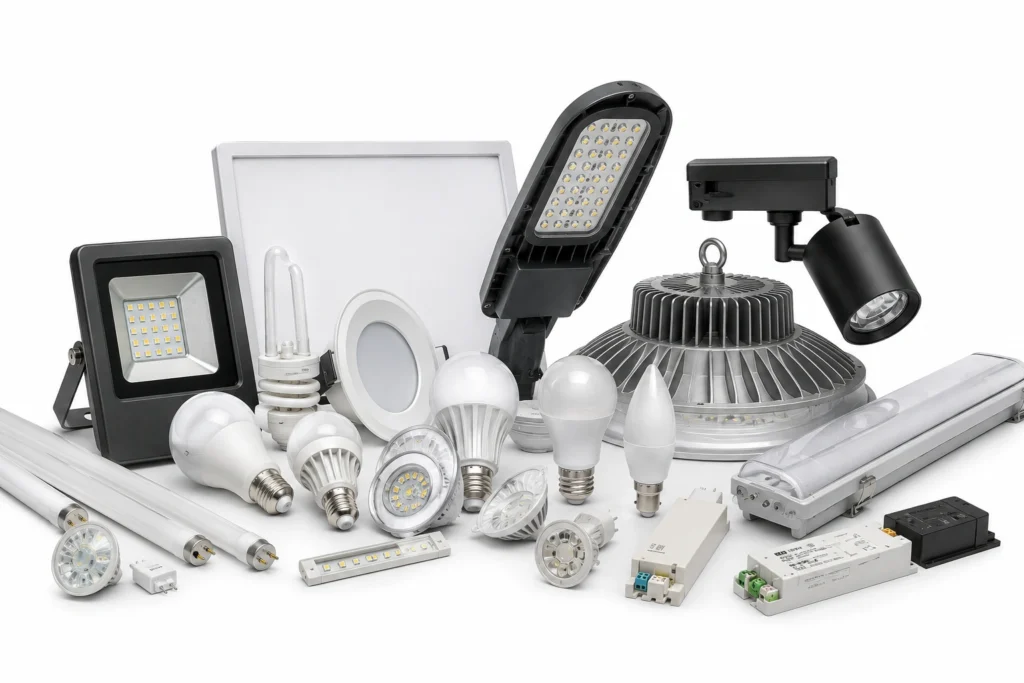
Lighting is an underestimated e-waste category. A standard household LED bulb contains an aluminium heatsink, a printed circuit board, LED chips, a capacitor, and a driver — all of which qualify as WEEE. Multiply that by the billions of bulbs in use globally and the scale becomes clear.
Different lighting technologies carry different material concerns.
| Type | Key Materials | Handling Note |
| Compact Fluorescent (CFL) | Mercury vapour, glass, aluminium | Mercury recovery required — do not break |
| LED Bulb | Indium, gallium, aluminium, PCB | Semiconductor compounds need specialist processing |
| Fluorescent Tube | Mercury, glass, aluminium end-caps | Volume commercial waste — bulk collection available |
| High-Intensity Discharge | Mercury, sodium, quartz glass | High-pressure vessel — handle with care |
| UV / Germicidal | Mercury, quartz glass | Often used in healthcare — decontamination first |
Businesses undergoing office fit-outs, retrofits, or smart lighting upgrades in the UAE and GCC generate significant volumes of lighting waste. Scheduling a collection before the works begin is simpler than dealing with mixed waste on-site.
6. Electrical Tools, Industrial Equipment, and Power Systems
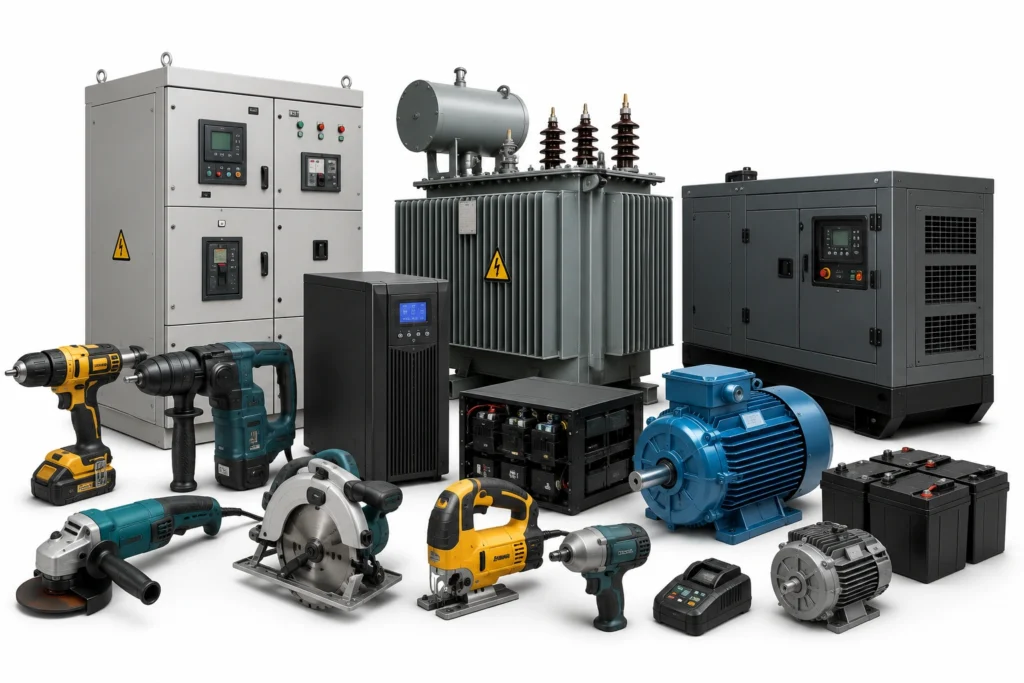
Power tools, industrial motors, UPS systems, generators, transformers, and electrical switchgear represent some of the highest-value e-waste by material composition. Copper windings in motors, precision electronics in control units, and lead-acid battery banks in UPS systems all have clear recovery pathways.
What Goes into This Category
- Power tools: drills, grinders, circular saws, welders, nail guns
- Garden equipment: electric mowers, leaf blowers, hedge trimmers
- Uninterruptible Power Supply (UPS) systems — common in data centres and offices
- Industrial motors, servo drives, and actuators
- Distribution panels and switchgear
- Diesel generators with electronic control modules
Cordless power tools typically contain lithium battery packs, which need to be separated from the tool body before processing. Businesses retiring workshop or site equipment in bulk will usually find that the scrap value of the metals offsets much of the collection cost.
7. Medical and Laboratory Electronic Equipment
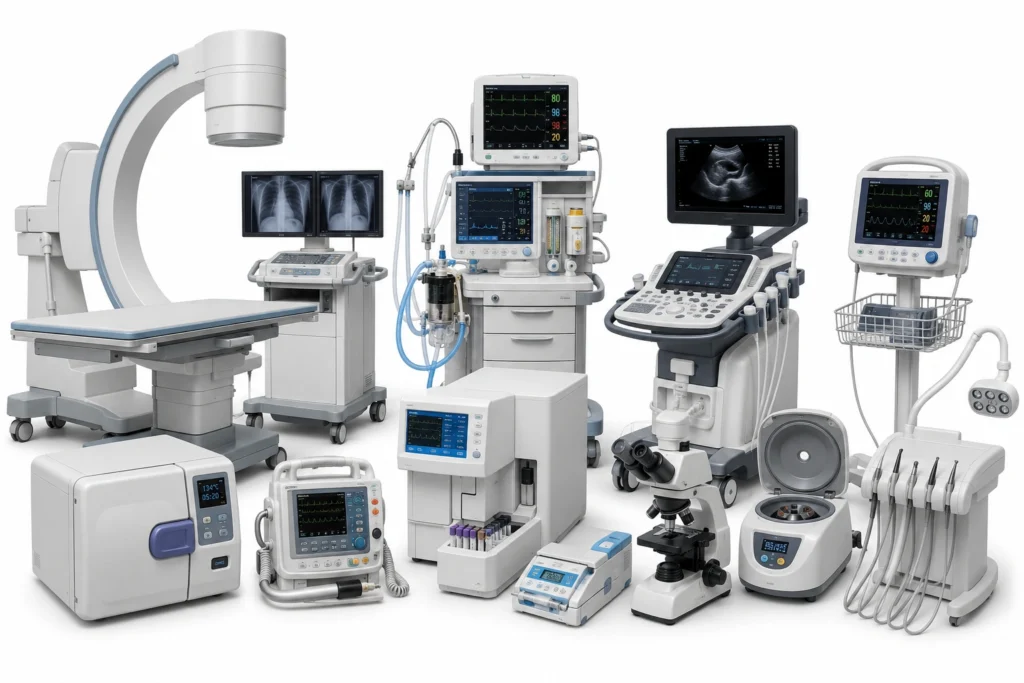
Medical e-waste sits at the intersection of electronics recycling and clinical waste management. Devices like X-ray machines, ventilators, heart monitors, laboratory analysers, and dental equipment contain high concentrations of precious metals alongside components that require decontamination before any recycling process begins.
| Device Type | Key Components | Special Handling |
| X-ray / CT Machines | High-voltage generators, detectors, lead shielding | Radiation safety sign-off required |
| MRI Machines | Superconducting magnets, RF coils, cryogenic systems | Cryogenic liquid handling required |
| Ventilators & ICU Equipment | Microprocessors, sensors, valves, battery packs | Clinical decontamination first |
| Laboratory Analysers | High-precision sensors, photomultipliers, electrodes | Reagent and chemical disposal separate |
| Dental Equipment | Compressors, X-ray sensors, handpieces | Silver amalgam recovery where applicable |
Healthcare facilities and private clinics in the UAE and Saudi Arabia that are working toward or maintaining accreditation typically need documented disposal records for all decommissioned equipment. A certified ITAD and recycling partner can supply the paperwork that accreditation audits require.
8. Solar Energy Systems and Renewable Energy Components
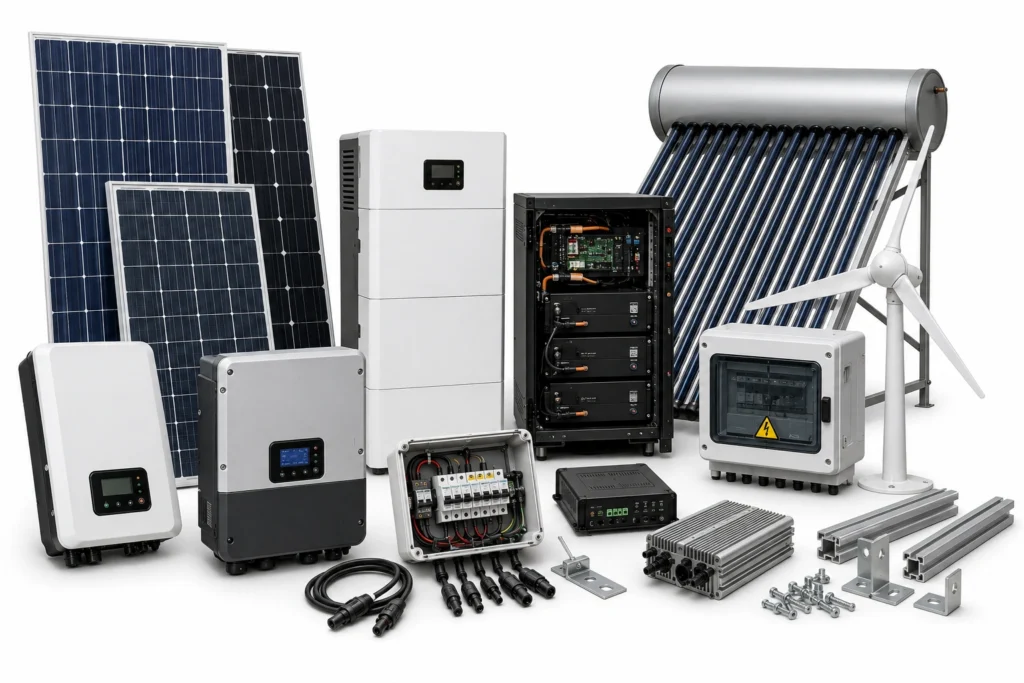
Solar panels installed in the early 2010s are now approaching the end of their 20–25 year design lifespan. The International Renewable Energy Agency (IRENA) estimates that cumulative end-of-life panel volume could reach 78 million tonnes by 2050. The challenge of solar panel recycling is only just beginning.
What a Solar System Generates as E-Waste
- Photovoltaic panels: aluminium frames, tempered glass, silicon cells, silver contact lines, lead/tin soldering
- Inverters: copper windings, aluminium heat sinks, electrolytic capacitors, semiconductor switches
- Battery storage systems: lithium-ion, lead-acid, or flow battery chemistries depending on installation date
- Charge controllers, combiner boxes, monitoring units
- Cabling and mounting hardware with embedded electronics
| Solar E-Waste in the UAE and GCC The UAE’s large-scale solar programmes — including Mohammed bin Rashid Al Maktoum Solar Park — will begin generating decommissioned equipment at scale over the next decade. Reloop Recycling FZE provides certified solar panel and inverter recycling with full documentation for ESG reporting and sustainability disclosures. |
9. Batteries, Cables, Chargers, and Electrical Accessories
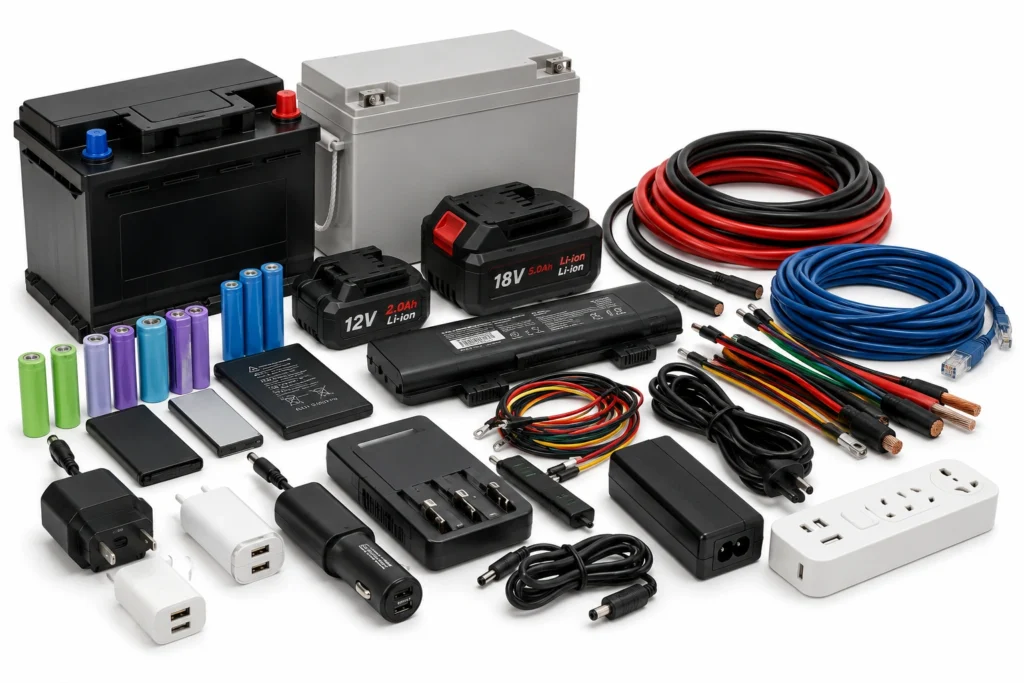
Batteries deserve their own category because of the handling complexity involved. The global lithium-ion battery market is projected to exceed $130 billion by 2030, and every cell sold will eventually reach end-of-life. Different battery chemistries behave differently in recycling streams — and some behave dangerously if mishandled.
| Battery Type | Common Uses | Key Materials | Handling Priority |
| Lithium-Ion (Li-ion) | Phones, laptops, EVs, power tools | Lithium, cobalt, nickel | High — cobalt supply chain concerns |
| Lead-Acid | UPS systems, vehicles, generators | Lead, sulphuric acid | High — well-established recycling stream |
| Nickel-Metal Hydride | Hybrid vehicles, older electronics | Nickel, rare earth alloys | High — nickel recovery value |
| Nickel-Cadmium | Power tools, emergency lighting | Cadmium | High — cadmium containment critical |
| Alkaline (primary) | Remote controls, toys | Manganese, zinc | Medium — lower recovery value |
| Lithium Primary | Medical devices, key fobs, sensors | Lithium metal | High — reactive, fire risk if damaged |
Lithium batteries — damaged, swollen, or otherwise compromised — should not be placed in general recycling bins. Lithium reacts with water and can ignite under pressure. Warehouse and refuse vehicle fires attributed to improperly discarded lithium batteries have increased noticeably in recent years across multiple markets. Use a dedicated battery collection service.
Cables, chargers, and extension leads also belong in e-waste channels. The copper inside them has genuine recovery value, and the PVC insulation can be processed separately. They are also easy to accumulate in drawers and storage rooms for years — most businesses have more of this category than they realise.
10. Toys, Wearables, Smart Gadgets, and e-Mobility Devices
Consumer electronics have spread into virtually every product category. Children’s toys now routinely contain microcontrollers, speaker drivers, and rechargeable cells. Fitness trackers and smartwatches are essentially miniature computers worn on the wrist. Electric scooters and bicycles carry substantial lithium battery packs.
Devices in This Category
- Battery-powered children’s toys with sound, light, and motion
- Wearables: smartwatches, fitness bands, continuous glucose monitors, AR glasses
- e-Mobility: electric bicycles, e-scooters, hoverboards, electric skateboards
- Consumer drones and UAVs
- Smart home devices: thermostats, video doorbells, security cameras, voice assistants
- Handheld and portable gaming devices
The e-mobility segment is particularly relevant across UAE cities where e-scooter rental fleets have grown significantly. The battery packs powering these fleets have finite lifespans and need certified handling at end-of-life. For fleet operators, this is increasingly a compliance consideration rather than an optional one.
How E-Waste Recycling Works
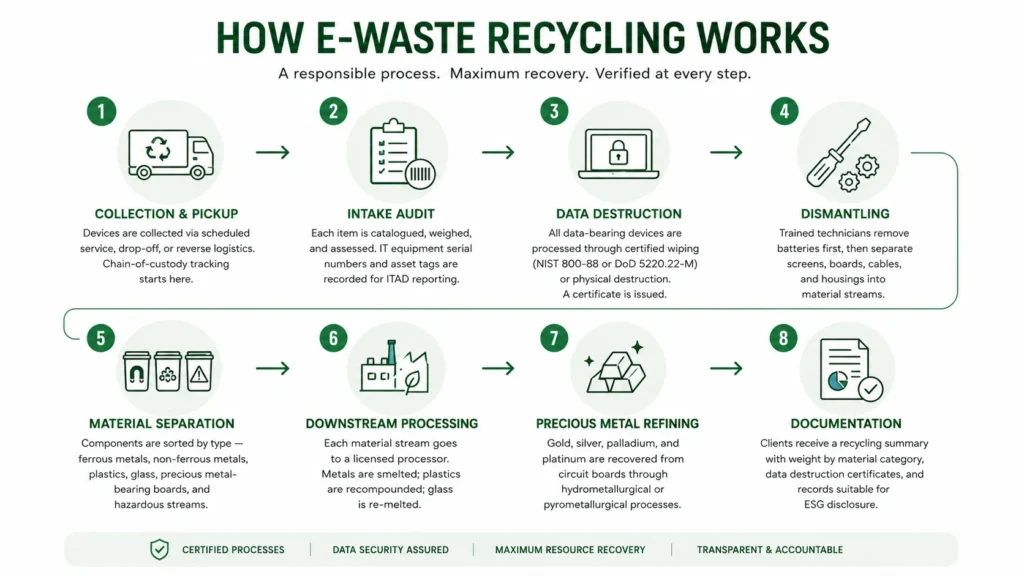
Professional e-waste recycling is not a single process — it is a sequence of steps, each designed to handle a specific material safely. At Reloop Recycling FZE, the workflow runs from collection through to material certification, with documentation at each stage.
- Collection and pickup: devices are collected via scheduled service, drop-off, or reverse logistics. Chain-of-custody tracking starts here.
- Intake audit: each item is catalogued, weighed, and assessed. IT equipment serial numbers and asset tags are recorded for ITAD reporting.
- Data destruction: all data-bearing devices are processed through certified wiping (NIST 800-88 or DoD 5220.22-M) or physical destruction. A certificate is issued.
- Dismantling: trained technicians remove batteries first, then separate screens, boards, cables, and housings into material streams.
- Material separation: components are sorted by type — ferrous metals, non-ferrous metals, plastics, glass, precious metal-bearing boards, and hazardous streams.
- Downstream processing: each material stream goes to a licensed processor. Metals are smelted; plastics are recompounded; glass is re-melted.
- Precious metal refining: gold, silver, palladium, and platinum are recovered from circuit boards through hydrometallurgical or pyrometallurgical processes.
- Documentation: clients receive a recycling summary with weight by material category, data destruction certificates, and records suitable for ESG disclosure.
Recycling Channels Compared
| Channel | Suitable For | Material Recovery | Data Security |
| Certified ITAD + Recycling | All business e-waste | 90–95% | Certified destruction with documentation |
| Manufacturer take-back | Consumer electronics | 60–75% | Varies by brand |
| Municipal collection points | Small household items | 50–65% | No guarantees |
| Retail drop-off programmes | Consumer devices, batteries | 55–70% | Basic handling only |
| General waste / landfill | Not appropriate for WEEE | 0% | None |
What’s Changing in E-Waste Management: 2026 Trends
Extended Producer Responsibility Expanding
Over 78 countries now have some form of EPR framework for WEEE. Draft regulations in the UAE under MOCCAE are expected to introduce producer responsibility obligations on electronics importers and manufacturers. For procurement and sustainability teams, this is worth monitoring as it may affect vendor selection criteria.
AI Sorting in Recycling Facilities
Several large e-waste processing facilities are deploying AI-powered robotic sorting systems capable of identifying components at speeds that manual teams cannot match. This is improving recovery rates for rare earth elements that would previously have been lost in mixed waste streams.
Battery Recycling Becoming a Priority
Electric vehicle adoption is driving urgent investment in lithium-ion battery recycling infrastructure across the GCC and globally. Saudi Arabia’s Vision 2030 and the UAE’s Net Zero 2050 Strategy both include elements that will shape how battery end-of-life is handled in the region.
Right to Repair
EU right-to-repair legislation that came into effect in 2024–2025 is extending the functional life of devices. The preferred disposition sequence is shifting: refurbish and redeploy before considering recycling. ITAD programmes that include refurbishment and remarketing reflect this.
ESG Documentation Requirements
CSRD in Europe and voluntary ESG frameworks globally are making e-waste disposal records a regular component of sustainability reporting. Businesses need documented, auditable proof of how their electronic assets were handled. Certified recycling partners who can supply that trail are becoming important to procurement processes.
How Businesses in the UAE and GCC Should Approach E-Waste
Start With an Inventory Audit
Before setting up any disposal programme, take stock of what the business actually holds. IT equipment issued to staff, on-site servers and network gear, warehouse or facility equipment, and vehicle fleet electronics are common categories that get overlooked in corporate e-waste planning.
Match Assets to the Right Disposal Pathway
| Asset Status | Recommended Action |
| Working, under 5 years old | Redeploy internally or donate — extends useful life |
| Working, 5–8 years old | Certified remarketing — recover residual value |
| Non-working, recoverable parts | ITAD with data destruction + component recovery |
| End-of-life, mixed materials | Certified recycling with compliance documentation |
| Any data-bearing device | Certified data destruction before any other step |
Choose a Certified Partner
When evaluating e-waste recycling providers, the certifications and capabilities to ask about include:
- R2v3 (Responsible Recycling Standard)
- ISO 14001 Environmental Management
- ISO 27001 Information Security Management
- NIST 800-88 or DoD 5220.22-M data destruction compliance
- Licensed hazardous waste transporter status in the relevant jurisdiction
- Chain-of-custody documentation and ESG-ready reporting
Keep Your Records
Recycling certificates, data destruction records, and asset disposal documentation should be retained. They serve compliance purposes, support ESG disclosures, and provide clarity in the event of a data audit or regulatory enquiry.
Related Services from Reloop Recycling FZE
| Service | Description |
| E-Waste Recycling | Certified collection and processing of all WEEE categories across UAE and GCC |
| IT Asset Disposition (ITAD) | End-to-end IT asset management: audit, data destruction, remarketing, recycling |
| Secure Data Destruction | Certified DoD/NIST-compliant wiping and physical destruction with full certificates |
| Battery Recycling | Safe collection and processing of all battery chemistries — Li-ion, lead-acid, and more |
| Reverse Logistics | Managed return, recovery, and redistribution of electronic assets at scale |
| ESG and Compliance Reporting | Verified recycling documentation for sustainability disclosures and audit trails |
Conclusions
E-waste is a broad category, and that breadth is part of what makes it challenging. It covers the phone in your pocket, the refrigerator in your kitchen, the solar panel on your roof, and the server in your data centre. Each of those generates a distinct waste stream with its own material profile, handling requirements, and recovery potential.
The global picture — less than a quarter of e-waste formally recycled — reflects how far disposal habits and infrastructure still need to travel. For businesses in the UAE and GCC, the combination of tightening regulation, growing ESG expectations, and the practical risks of unsecured data disposal makes having a defined e-waste strategy worth the effort.
The starting point is knowing what you have. From there, a certified ITAD and recycling partner can handle the logistics, the documentation, and the downstream processing.
Frequently Asked Questions
1. What counts as e-waste?
Any product that runs on electricity or contains a battery is e-waste when discarded. This covers smartphones, computers, refrigerators, medical equipment, solar panels, power tools, LED lights, electric toys, and e-mobility devices. If it plugs in or takes a battery, it qualifies.
2. Can I put e-waste in my regular recycling bin?
No. E-waste contains materials that need separate processing — some valuable, some hazardous. Standard recycling facilities are not equipped to handle them. Most municipalities and retail chains offer dedicated drop-off points, and businesses can arrange scheduled collections through certified providers.
3. How should a business dispose of old IT equipment?
The process starts with certified data destruction — software wiping or physical media destruction — before any device leaves the premises. From there, working assets may go through a remarketing programme; non-working equipment goes for certified recycling. A reliable ITAD provider documents both steps and issues the necessary certificates.
4. Is there any financial return from e-waste recycling?
For businesses with meaningful volumes of IT equipment, yes. Precious metals on circuit boards have real scrap value, and working or near-working devices can be refurbished and sold. The net return depends on equipment age, condition, and mix. An ITAD provider can give a preliminary assessment before collection.
5. What actually happens to data when a device is recycled?
In a certified process, storage media goes through software-based overwriting using NIST 800-88 or DoD 5220.22-M standards, or physical destruction — degaussing, shredding, or disintegration. The provider issues a certificate of destruction documenting the method used and the devices covered.
6. Do solar panels count as e-waste?
Yes. Photovoltaic panels, inverters, battery storage units, and associated electrical components are classified as WEEE. End-of-life panels contain cadmium telluride (in thin-film types), silicon compounds, lead solder, and recoverable silver and aluminium — all of which benefit from proper recycling rather than landfill.
7. How do healthcare facilities handle medical equipment disposal?
Medical devices typically need clinical decontamination before any recycling process begins. Facilities working toward accreditation generally need documented disposal records for decommissioned equipment. A recycling partner with experience in medical WEEE can handle the logistics and supply the documentation.
8. What is ITAD?
IT Asset Disposition (ITAD) is the process of managing end-of-life or surplus IT equipment in a documented, auditable way. It covers data destruction, asset inventory, remarketing of working equipment, and certified recycling of items that cannot be resold. The key distinction from standard recycling is the data security component and the level of documentation involved.
9. What is the difference between e-waste recycling and ITAD?
E-waste recycling focuses on recovering materials from discarded devices. ITAD starts earlier — with data security and asset management — and includes recycling as the final step for equipment that cannot be refurbished or resold. All ITAD includes recycling at the end, but recycling alone does not cover the data or asset recovery elements.
10. How can businesses in the UAE arrange e-waste collection?
Reloop Recycling FZE offers scheduled collection services across the UAE and GCC for businesses of all sizes. For smaller volumes, drop-off points are available through certain retailers and municipal programmes in Dubai (DEWA), Abu Dhabi (TADWEER), and Sharjah (BEEAH). Visit www.reloopglobal.com to arrange a collection or request a quote.
11. What certifications should I look for in a recycling partner?
R2v3, e-Stewards, ISO 14001, ISO 27001, and compliance with the local regulatory framework in your jurisdiction. For data-bearing equipment specifically, ask to see a sample data destruction certificate and confirm which wiping standard the provider uses before committing.
12. What does the circular economy mean in practice for e-waste?
In practice it means treating end-of-life electronics as a resource rather than a disposal problem. Working devices get refurbished and reused. Materials from non-working devices get recovered and fed back into manufacturing supply chains. The goal is to close the loop — keeping materials in use as long as possible and reducing the demand for virgin resource extraction.

Raju Lajwani
 Connect on LinkedIn