The artificial intelligence boom has created an unprecedented demand for compute power — and an equally unprecedented wave of hardware turnover. Enterprises are refreshing GPU clusters, retiring AI servers, and decommissioning data center racks faster than ever before. That leaves IT, procurement, and sustainability teams with a critical question: what happens to AI hardware once it’s no longer needed?
This guide walks through everything enterprise organizations need to know about AI hardware recycling in 2026 — from GPU recycling and secure ITAD (IT Asset Disposition) to data destruction, material recovery, and compliance best practices.
What Is AI Hardware Recycling?
AI hardware recycling is the structured process of collecting, sanitizing, refurbishing, and responsibly disposing of the physical infrastructure that powers artificial intelligence workloads — GPUs, AI-optimized servers, storage arrays, and networking equipment. Unlike traditional e-waste recycling, AI hardware recycling has to account for the unique realities of this equipment class: extremely high per-unit value, dense concentrations of sensitive data, and specialized components (like GPU dies, HBM memory, and liquid-cooling assemblies) that require careful handling to recover safely and profitably.
At its core, AI hardware recycling combines three disciplines: secure data destruction, IT asset disposition (ITAD), and environmentally responsible materials recovery. Done correctly, it protects an organization’s data, recovers financial value from retired assets, and keeps hazardous materials out of landfills.
Why AI Hardware Recycling Matters
The scale of AI infrastructure turnover is enormous and growing. Hyperscalers, cloud providers, and enterprises are cycling through GPU generations every 18–24 months to keep pace with model training and inference demands. Each refresh cycle generates thousands of retired GPUs, servers, and storage devices — many of which still hold enterprise data and significant resale or material value.
There are four main reasons AI hardware recycling has become a board-level priority:
- Data exposure risk. Retired AI servers and GPUs often retain cached datasets, model weights, credentials, and configuration files. Improper disposal is a direct data breach risk.
- Regulatory pressure. Data protection laws, e-waste regulations, and ESG disclosure requirements increasingly hold organizations accountable for how they dispose of IT assets.
- Resource scarcity. GPUs and servers contain gold, copper, rare earth elements, and semiconductor materials that are costly and environmentally intensive to mine. Recovering them reduces reliance on virgin extraction.
- Financial recovery. Retired AI hardware — particularly GPUs less than three years old — often retains substantial resale value on the secondary market, offsetting the cost of new infrastructure.
Types of AI Hardware That Can Be Recycled
AI GPUs
Graphics processing units are the engine of modern AI, and they’re also the most valuable and most sensitive component in the recycling stream. This includes training-class accelerators, inference cards, and legacy GPUs displaced by newer architectures. Because GPUs can retain firmware-level data and carry high resale value, they require specialized handling that differs significantly from standard e-waste processing.
AI Servers
AI-optimized servers — including GPU-dense rack and blade servers, liquid-cooled systems, and specialized AI appliances — make up the backbone of data center recycling programs. These systems typically include multiple storage drives, network interface cards, and firmware layers that must be sanitized before any component leaves the facility.
Storage & Networking Equipment
AI workloads generate and move enormous volumes of data, which means the storage and networking layer supporting them — SSDs, NVMe arrays, switches, routers, and interconnects — carries its own data security and recycling requirements. These components are often overlooked in favor of higher-profile GPUs and servers, but they pose equal or greater data risk.
| Hardware Type | Examples | Key Recycling Consideration | Typical Value Recovery |
|---|---|---|---|
| AI GPUs | Training accelerators, inference cards, legacy GPUs | Firmware/memory sanitization; high resale demand | High — active secondary market |
| AI Servers | GPU-dense racks, blade servers, liquid-cooled systems | Multiple data-bearing components; custom chassis | Medium–High depending on configuration |
| Storage & Networking | SSDs, NVMe arrays, switches, routers, interconnects | Often overlooked but carries equal data risk | Low–Medium; mostly material recovery |
AI Hardware Recycling Process
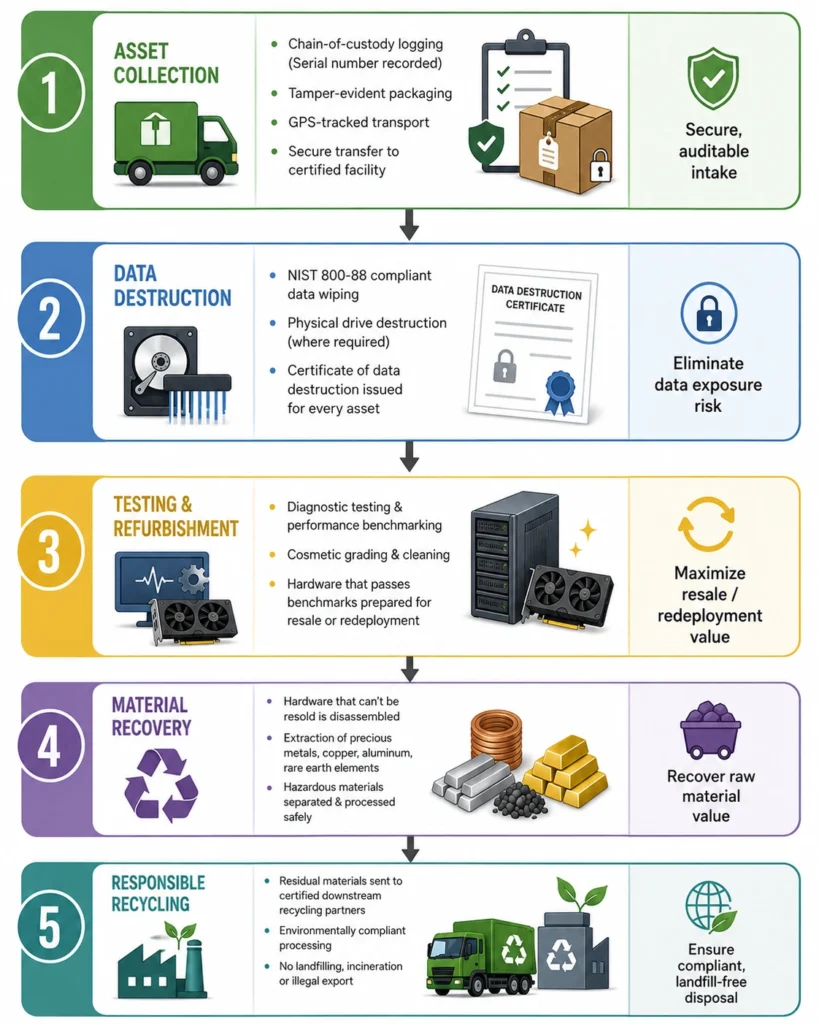
A defensible AI hardware recycling program follows a documented, auditable process from the moment equipment is decommissioned to its final disposition.
| Stage | What Happens | Primary Goal |
|---|---|---|
| 1. Asset Collection | Chain-of-custody logging, tamper-evident packaging, GPS-tracked transport | Secure, auditable intake |
| 2. Data Destruction | NIST 800-88 wiping or physical drive destruction | Eliminate data exposure risk |
| 3. Testing & Refurbishment | Diagnostic benchmarking, cosmetic grading | Maximize resale/redeployment value |
| 4. Material Recovery | Extraction of metals and rare earth elements | Recover raw material value |
| 5. Responsible Recycling | Downstream certified partner processing | Ensure compliant, landfill-free disposal |
GPU Recycling: How AI Graphics Cards Are Recycled
GPU recycling deserves special attention because these components sit at the intersection of high data sensitivity and high residual value. The process typically includes:
- Firmware and memory sanitization — clearing any cached data, model artifacts, or configuration settings stored on-board.
- Functional testing — running the GPU through stress tests and diagnostic benchmarks to verify thermal performance, memory integrity, and compute output.
- Grading and valuation — assessing cosmetic and functional condition to determine whether the unit is suitable for resale, component harvesting, or material recovery.
- Resale or redeployment — functional GPUs are remarketed through secondary channels, often to organizations running less demanding workloads, academic institutions, or smaller AI startups.
- Component-level recovery — for units that fail testing, individual components (memory modules, capacitors, connectors) may still hold recoverable value before the board is processed for raw materials.
Because GPU markets move quickly and pricing is volatile, working with a recycler who has active resale channels — rather than one that treats every GPU as scrap — makes a measurable difference in value recovery.
AI Server Recycling & Secure ITAD
AI servers present a more complex recycling challenge than standalone GPUs because they combine multiple data-bearing components, custom configurations, and often proprietary chassis designs. A proper AI server ITAD program includes:
- On-site or in-transit data destruction options for organizations with strict security requirements that prohibit intact drives from leaving the premises.
- Full asset inventory and serialization, matching each server, drive, and card to a documented chain of custody.
- Component disassembly, separating GPUs, CPUs, RAM, storage, and power supplies for independent testing and valuation.
- Compliance documentation, including certificates of destruction and recycling that satisfy SOC 2, HIPAA, GDPR, and other regulatory frameworks.
- Liquid-cooling system handling, since many modern AI servers use direct-to-chip or immersion cooling that requires specialized draining and material handling procedures.
Enterprises evaluating an ITAD partner for AI servers should confirm the vendor has direct experience with GPU-dense, high-density rack systems — not just conventional enterprise servers.
Benefits of AI Hardware Disposal
Data Security
Certified data destruction eliminates the risk of sensitive information — training data, proprietary models, customer records, or credentials — being recovered from decommissioned hardware. This is arguably the single most important benefit of a formal recycling program, given how much intellectual property now lives on AI infrastructure.
ESG Compliance
Responsible hardware disposal supports corporate ESG goals and simplifies sustainability reporting. Documented recycling volumes, landfill diversion rates, and material recovery data feed directly into environmental disclosures that investors, regulators, and customers increasingly expect.
Asset Value Recovery
Because AI hardware — especially GPUs — retains meaningful resale value for several years after deployment, a well-run recycling program can offset a significant portion of new infrastructure spend. Organizations that treat retired hardware as scrap rather than a resalable asset routinely leave money on the table.
Environmental Impact
Recovering metals and rare earth elements from retired hardware reduces the need for new mining and manufacturing, lowering the overall carbon and environmental footprint of AI infrastructure. Given how energy- and resource-intensive AI hardware production already is, closing the loop on end-of-life equipment is an increasingly important sustainability lever.
Best Practices for AI Hardware Disposal
- Inventory before you decommission. Maintain an accurate, serialized asset register so nothing falls through the cracks during a refresh cycle.
- Choose a certified ITAD partner. Look for credentials such as R2v3, e-Stewards, or NAID AAA certification, which verify a vendor’s data destruction and environmental practices.
- Demand documentation. Insist on certificates of data destruction and recycling for every asset, not just a summary report.
- Plan disposal into procurement. Build end-of-life logistics into hardware refresh budgets and timelines rather than treating disposal as an afterthought.
- Separate high-value components early. GPUs and high-density servers should be flagged for specialized handling rather than mixed into general e-waste streams.
- Verify downstream chain of custody. Ask where materials go after initial processing to confirm nothing is exported to unregulated facilities.
Why Choose Reloop Recycling for AI Hardware Recycling?
Reloop Recycling specializes in the secure, compliant, and value-maximizing disposition of AI infrastructure — from single GPU pallets to full data center decommissions. Our process combines certified data destruction, rigorous functional testing, and active secondary-market resale channels to help enterprises recover value while eliminating data and compliance risk.
Every engagement includes full chain-of-custody tracking, serialized asset reporting, and documented certificates of data destruction and recycling — giving your security, procurement, and sustainability teams the audit trail they need. Whether you’re refreshing a GPU cluster, retiring an AI server fleet, or managing a full facility shutdown, Reloop Recycling provides the specialized expertise that general e-waste vendors simply don’t have.
Ready to Recycle Your AI Hardware?
Securely retire GPUs, AI servers, and data center equipment with certified data destruction, maximum value recovery, and complete compliance.
Get a Free Consultation →Frequently Asked Questions About AI Hardware Recycling
Is it safe to sell or recycle a GPU that was used for AI training? Yes, as long as it goes through certified data sanitization first. Reputable ITAD providers wipe or destroy any data on the device before it’s tested, resold, or broken down for materials.
How much value can I recover from retired AI servers? It depends heavily on the age, configuration, and GPU generation involved. Servers less than three years old with in-demand GPUs can often recover substantial resale value, while older or damaged units are typically processed for material recovery instead.
Can liquid-cooled AI servers be recycled? Yes, but they require specialized handling to safely drain coolant and separate cooling infrastructure from compute components. Confirm your ITAD partner has direct experience with liquid-cooled systems before shipping equipment.
What happens to data on decommissioned AI hardware? Data-bearing components undergo certified data destruction — typically software-based wiping that meets NIST 800-88 standards, or physical destruction for drives that can’t be securely wiped — before any testing, resale, or recycling occurs.
Do I need a certificate of destruction for compliance purposes? Yes. Most regulatory frameworks (GDPR, HIPAA, SOC 2, and various state data protection laws) expect documented proof that data was destroyed, not just a verbal assurance. Always request certificates for every asset processed.
Conclusion
As AI adoption accelerates, so does the volume of retired GPUs, servers, and supporting infrastructure moving through enterprise IT departments. Treating this equipment as an afterthought creates unnecessary data security risk, leaves financial value unrecovered, and undermines sustainability commitments. A structured AI hardware recycling program — built on secure data destruction, rigorous testing, and responsible material recovery — turns that risk into an opportunity.
Organizations that partner with an experienced ITAD provider like Reloop Recycling can retire AI hardware with confidence, knowing their data is protected, their compliance obligations are met, and their retired infrastructure is put to its highest and best use.