Every year, businesses lose millions of dollars and countless hours of trust because a hard drive, laptop, or old server was thrown away instead of properly destroyed. Data doesn’t disappear when you hit “delete” – it sits recoverable on a device until it’s physically or digitally wiped beyond recovery. That’s where secure data destruction comes in.
This guide covers everything you need to know: what secure data destruction is, which devices need it, the most secure destruction methods, how chain of custody works, what certifications matter, and how to choose the right secure data destruction company for your business.
What Is Secure Data Destruction and Why Is It Important?
Secure data destruction is the permanent, irreversible elimination of data from a storage device so it can never be accessed, recovered, or reconstructed. It matters because deleted files, factory resets, and reformatted drives all leave recoverable data behind – putting businesses at risk of breaches, compliance violations, and legal penalties.
This is different from simply deleting a file or reformatting a drive. Deleting a file only removes its reference in the file system – the actual data remains on the device until it’s overwritten. Anyone with basic data recovery software can retrieve “deleted” files. True secure data destruction goes further, using certified methods to make data recovery technically impossible.
Why it matters:
- Data breaches from improperly discarded devices are a real and growing risk. Old drives sold, donated, or thrown away with recoverable data are a common breach source.
- Regulatory penalties can be severe. Laws like HIPAA, GDPR, and FACTA require businesses to prove sensitive data was destroyed properly.
- Reputational damage is hard to undo. A single leaked customer database can cost a company years of earned trust.
Why Every Business Needs Secure Data Destruction Services
Every business needs secure data destruction services because any device that has ever stored sensitive data – customer records, financial information, employee files – remains a breach risk until that data is permanently destroyed. This applies regardless of company size or industry.
| Risk of Skipping Secure Destruction | Business Impact |
| Recoverable data on resold/donated devices | Data breach, identity theft exposure |
| Non-compliance with data protection laws | Regulatory fines, legal action |
| No documented proof of destruction | Failed audits, lost contracts |
| Employee offboarding devices left unwiped | Insider data leaks |
| Improper e-waste disposal | Environmental fines, brand damage |
Professional secure data destruction services eliminate this risk entirely by using certified methods and providing documented proof – a Certificate of Data Destruction – that data was permanently destroyed.
Which Devices Require Secure Data Destruction?
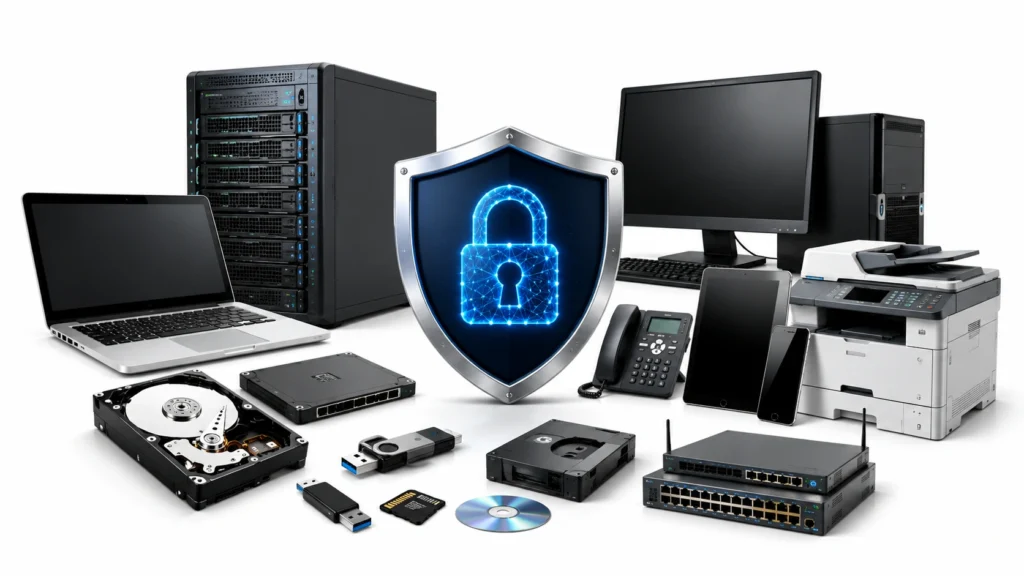
Any device that stores or has ever stored data requires secure data destruction before disposal, resale, or recycling – not just computers.
Common devices requiring secure data destruction:
- Hard drives (HDDs) and solid-state drives (SSDs)
- Servers and data center hardware
- Laptops, desktops, and workstations
- Mobile phones and tablets
- Backup tapes, USB drives, CDs, and DVDs
- Networking equipment (routers, switches with saved configurations)
- Copiers and printers with internal storage
If it stores data, it needs to be destroyed properly – not just wiped and hoped for the best.
What Are the Most Secure Data Destruction Methods?
The most secure data destruction methods are data erasure, hard drive shredding, SSD destruction, and degaussing – each suited to a different device type and security need.
| Method | Best For | Device Reusable? | Security Level |
| Data Erasure (Software Wiping) | HDDs, SSDs still in working order | Yes | High |
| Hard Drive Shredding | End-of-life HDDs | No | Very High |
| SSD Destruction | End-of-life SSDs | No | Very High |
| Degaussing | HDDs, magnetic tape | No | Very High (HDD/tape only) |
Data Erasure (Software Wiping)
Data erasure is a software-based method that overwrites every sector of a drive – often multiple times – following standards like NIST 800-88, making the original data unrecoverable while keeping the device fully functional.
Best for: Businesses that want to resell, donate, or redeploy devices while still meeting compliance standards.
Limitation: Not effective on physically damaged or failed drives.
Hard Drive Shredding
Hard drive shredding is the physical destruction of a drive using industrial shredders, reducing it to fragments too small to reassemble or read – widely considered the gold standard for HDD destruction.
Best for: End-of-life drives, high-security environments, and businesses that need undeniable proof of destruction for compliance audits.
SSD Destruction
SSD destruction requires specialized shredding or crushing equipment because solid-state drives store data across flash memory chips using wear-leveling technology, meaning standard HDD methods like degaussing don’t work on them at all.
Best for: End-of-life SSDs, laptops, and mobile devices with solid-state storage.
Degaussing
Degaussing uses a powerful magnetic field to instantly scramble the magnetic domains on a hard drive or backup tape, erasing the data – but it only works on magnetic media and permanently disables the device.
Best for: Highly classified or sensitive data on HDDs and magnetic tape where speed and certainty matter more than device reuse.
Onsite vs. Offsite Secure Data Destruction: Which Is Better?
Onsite secure data destruction happens at your location for maximum visibility and control, while offsite secure data destruction takes place at a certified facility and is often more cost-effective for large volumes – the better option depends on your data sensitivity and device count.
| Factor | Onsite Secure Data Destruction | Offsite Secure Data Destruction |
| Where it happens | On your premises, often via mobile shredding truck | At a certified destruction facility |
| Security | Highest – data never leaves your sight | Requires trusted transport and chain of custody |
| Cost | Typically higher per visit | Often more cost-effective for large volumes |
| Turnaround | Immediate, same-day destruction | Slightly longer due to transport and processing |
| Best for | Highly regulated industries, small-to-mid volume | Large-scale IT asset disposition (ITAD) projects |
Answer: If your organization handles highly sensitive data (healthcare records, financial data, government files), onsite destruction offers maximum control and peace of mind. If you’re decommissioning a large volume of equipment through a trusted, certified provider, offsite destruction with a documented chain of custody can be equally secure and more cost-efficient.
How Does the Secure Chain of Custody Process Work?
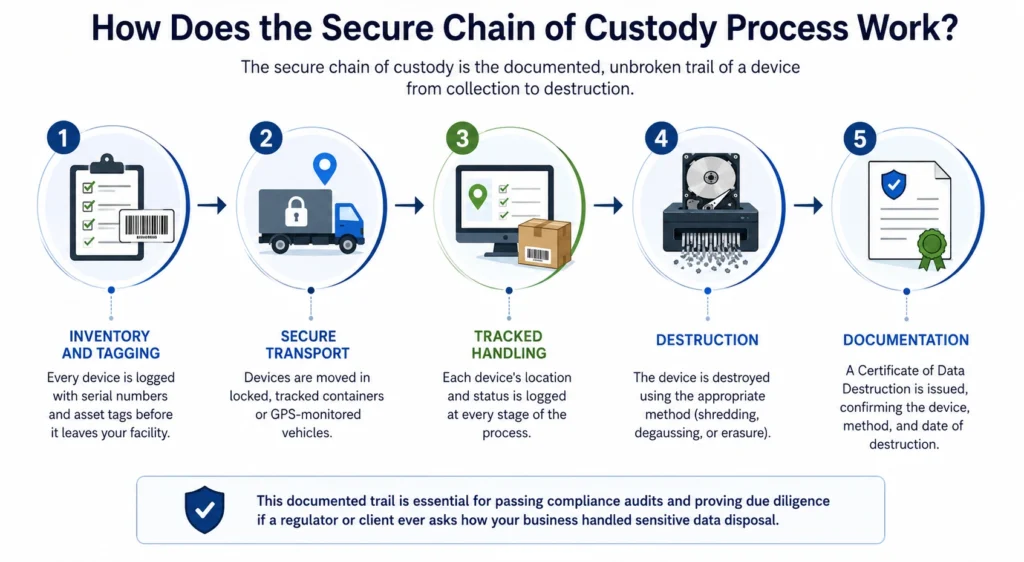
The secure chain of custody process is the documented, unbroken trail of a device from collection to destruction – inventory and tagging, secure transport, tracked handling, destruction, and final documentation – and it’s what makes data destruction defensible in an audit.
A proper chain of custody process typically follows these steps:
- Inventory and tagging – Every device is logged with serial numbers and asset tags before it leaves your facility.
- Secure transport – Devices are moved in locked, tracked containers or GPS-monitored vehicles.
- Tracked handling – Each device’s location and status is logged at every stage of the process.
- Destruction – The device is destroyed using the appropriate method (shredding, degaussing, or erasure).
- Documentation – A Certificate of Data Destruction is issued, confirming the device, method, and date of destruction.
This documented trail is essential for passing compliance audits and proving due diligence if a regulator or client ever asks how your business handled sensitive data disposal.
What Certifications Should a Secure Data Destruction Company Have?
A secure data destruction company should hold NAID AAA Certification, e-Stewards Certification, ISO 27001, and ISO 14001 – these are the clearest, independently verified signals that a vendor follows industry-recognized destruction and security standards.
- NAID AAA Certification – The industry gold standard, verified through unannounced audits of destruction processes, employee screening, and security protocols.
- e-Stewards Certification – Focused on responsible, environmentally sound handling of electronic waste and data-bearing devices.
- ISO 27001 – International standard for information security management systems.
- ISO 14001 – International standard for environmental management, relevant to IT Asset Disposition (ITAD) and e-waste recycling.
A vendor holding these certifications is independently verified – not just self-declared – which matters enormously if your business is ever audited.
How to Choose the Best Secure Data Destruction Company
The best secure data destruction company holds verified certifications, offers both onsite and offsite options, provides a Certificate of Data Destruction, and maintains a transparent chain of custody for every device processed.
- Holds verified certifications (NAID AAA, e-Stewards, ISO 27001)
- Offers both onsite and offsite secure data destruction options
- Provides a Certificate of Data Destruction for every job
- Maintains a transparent, documented chain of custody
- Carries adequate insurance and liability coverage
- Follows environmentally responsible recycling practices
- Has experience serving your specific industry and compliance needs
- Is locally available if you’re searching “secure data destruction near me”
Red flags to avoid: vendors with no verifiable certifications, no written documentation, vague or unusually low pricing, or reluctance to explain their destruction process in detail.
How Much Do Secure Data Destruction Services Cost?
Secure data destruction services typically cost based on the method used, device volume, and whether service is onsite or offsite – pricing is usually structured per device, per pound, or as a flat rate for onsite visits.
- Method used – software wiping is typically the least expensive; physical shredding and degaussing cost more due to equipment and labor.
- Volume of devices – larger volumes often reduce the per-device cost.
- Onsite vs. offsite service – onsite destruction generally costs more due to mobile equipment and travel.
- Documentation requirements – certified reporting and chain-of-custody tracking may add a small fee.
- One-time vs. recurring service – businesses with ongoing IT asset disposition needs often negotiate contract pricing.
While cost matters, it’s worth weighing against the alternative: the average cost of a single data breach far exceeds what secure destruction services charge. Request a custom quote based on your device count and destruction method for the most accurate pricing.
Industries That Need Secure Data Destruction the Most
Healthcare, financial services, legal firms, government contractors, retail, education, and enterprise IT need secure data destruction the most because each handles data protected by strict regulatory compliance requirements.
- Healthcare – HIPAA compliance for patient records
- Financial services and banking – FACTA and PCI-DSS requirements for financial data
- Legal firms – Attorney-client confidentiality obligations
- Government and defense contractors – Classified and controlled data handling standards
- Retail and e-commerce – Protection of customer payment information
- Education – FERPA compliance for student records
- Corporate and enterprise IT – Protection of employee data and trade secrets
Frequently Asked Questions About Secure Data Destruction
What’s the difference between data destruction and data erasure? Data erasure overwrites data using software, leaving the device functional and reusable. Data destruction physically destroys the device, making both the data and the hardware unusable.
Is a factory reset enough to protect my data? No. A factory reset removes visible files but doesn’t overwrite the underlying data, which can often still be recovered with basic software.
What happens if I don’t destroy old hard drives properly? Recoverable data on discarded drives can be accessed by anyone who obtains the device, leading to potential data breaches, compliance violations, and legal liability.
Do I get proof that my data was destroyed? Yes. Reputable providers issue a Certificate of Data Destruction listing the device, method used, and date of destruction for your compliance records.
Can destroyed devices still be recycled? Yes. Certified providers typically recycle the destroyed materials responsibly as part of their e-waste and IT Asset Disposition (ITAD) process.
How long does secure data destruction take? Onsite destruction is often completed the same day. Offsite destruction may take a few business days depending on transport and processing schedules.
Is onsite or offsite destruction more secure? Both can be equally secure when handled by a certified provider. Onsite offers direct visibility, while offsite relies on a documented, trusted chain of custody.
Why Choose Reloop for Secure Data Destruction Services?
Reloop is a secure and certified data destruction company offering onsite and offsite services, documented chain of custody, and a Certificate of Data Destruction for every device processed – giving businesses complete compliance peace of mind.
Every device destroyed through Reloop comes with a Certificate of Data Destruction, giving you the documentation you need for audits, compliance, and client assurance. Whether you’re a healthcare provider, financial institution, law firm, or growing enterprise, Reloop’s secure data destruction company services are built around your industry’s specific compliance needs.
Ready to protect your business data? Contact Reloop today to request a quote or schedule a secure data destruction pickup.