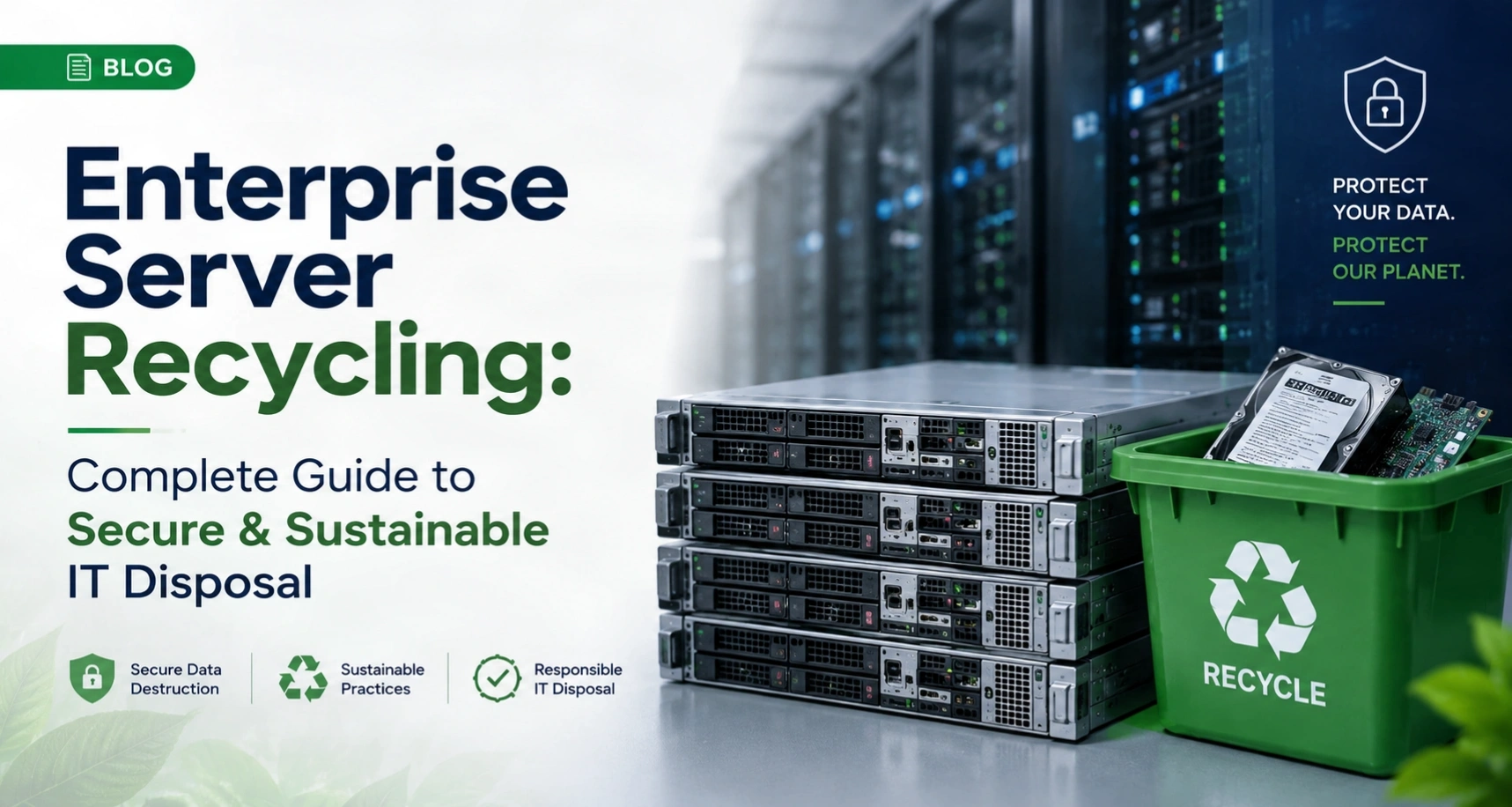
A factory reset is not data destruction. Dropping hardware at a general e-waste facility is not compliance. This guide gives IT directors, compliance officers, and sustainability managers everything they need — process, regulations, certifications, and the right questions to ask before any server leaves your facility.
What Is Enterprise Server Recycling?
Enterprise server recycling is the structured, audited process of collecting, sanitizing, and responsibly disposing of end-of-life server hardware. It is not a trip to the municipal e-waste bin — it is a chain-of-custody-controlled operation that handles data security, regulatory compliance, and material recovery at the same time.
Most people confuse it with ITAD (IT Asset Disposition), but the two are different in scope. Recycling covers end-of-life material processing. ITAD covers the entire decommission lifecycle: asset auditing, certified data destruction, refurbishment and remarketing of usable hardware, and final recycling of what remains. For any organization with compliance obligations, ITAD is the correct engagement — recycling alone won’t satisfy GDPR, HIPAA, or PCI DSS.
Virtually all enterprise hardware is eligible: rack and blade servers, storage arrays, network switches, routers, UPS units, and telecom equipment. Even physically damaged or non-functional hardware can be processed – data destruction and material recovery work regardless of whether the equipment powers on.
Why Secure Server Disposal Matters
Researchers have repeatedly purchased decommissioned enterprise drives on secondary markets and recovered banking credentials, healthcare records, and source code. The drives weren’t stolen – they simply weren’t wiped before disposal.
The financial exposure is real. A data breach now costs enterprises an average of $4.9 million (IBM, 2024). Regulatory penalties on top of that can be equally severe: GDPR violations carry fines up to €20 million or 4% of global annual revenue, HIPAA violations up to $1.9 million per category, and PCI DSS non-compliance can trigger up to $100,000 per month in fines plus card scheme penalties.
Beyond the numbers, the reputational damage from a disposal-related breach is the kind that follows a company for years. And unlike a network intrusion, it is entirely preventable.
The Only Acceptable Destruction Methods
Software wiping to NIST 800-88 overwrites all addressable storage locations and generates a tamper-proof report tied to each drive’s serial number. It’s the right choice for hardware being refurbished and remarketed.
Physical shredding reduces drives to fragments smaller than 2mm — recovery is physically impossible. This is the standard for healthcare, financial services, government, and any environment where even a theoretical risk of recovery is unacceptable. On-site witnessed shredding, where equipment is destroyed at your facility with video documentation, eliminates transport risk entirely.
A factory reset achieves neither. It removes the pointer to the data. The data itself stays intact and is recoverable with free tools.
The Enterprise Server Recycling Process
A professional ITAD engagement runs in six stages, each with its own documentation checkpoint.
1. Asset discovery and auditing. Every piece of hardware is catalogued — make, model, serial number, drive configuration — before anything is disconnected. This inventory is the foundation of your chain-of-custody documentation.
2. Secure decommissioning. Systematic disconnection from network infrastructure, removal from monitoring and licensing systems, and sign-off from compliance or IT security teams. In regulated industries, this step requires documented approval before hardware moves.
3. Data destruction. Certified software wiping or physical shredding, chosen based on the sensitivity classification of stored data. Every drive receives an individual destruction report. This happens before hardware leaves your control, or immediately upon receipt at a certified facility.
4. Secure transport. GPS-tracked, sealed freight with full manifest documentation. Chain of custody transfers at each handoff are recorded. No co-mingling with other clients’ assets.
5. Remarketing or material recovery. Functional hardware is graded for refurbishment and remarketing — generating residual value that offsets program costs. Hardware that can’t be economically refurbished is disassembled for material-specific recycling streams.
6. Documentation. A complete disposition package: Certificate of Data Destruction (per asset, per serial number), Certificate of Recycling, and full asset reconciliation. For ESG reporting, a material recovery summary and diversion-from-landfill metrics are included.
A generic batch certificate is not sufficient for a GDPR or HIPAA audit. Per-asset serial number documentation is the only acceptable standard.
Data Center Server Recycling & ITAD
Data center decommissioning is a different scale of problem. A single project can involve hundreds of servers, petabytes of storage, and equipment from multiple tenants — each with different compliance requirements, different data classifications, and different destruction standards.
The operational risks are significant: a single missed asset leaves an unwiped drive outside the chain of custody; taking systems offline in the wrong order disrupts live operations; multi-tenant environments risk co-mingling data across client boundaries. Cooling equipment requires refrigerant recovery under environmental regulations. UPS units contain lead-acid batteries that are hazardous waste.
A capable ITAD partner brings a dedicated project manager, a pre-decommission discovery scan, a phased decommission schedule built around business continuity, and per-tenant destruction events with separate documentation for each. The output is a unified reporting package that covers every asset across the entire facility.
Environmental Benefits of Server Recycling
The environmental argument for proper recycling is material, not marketing. A tonne of enterprise circuit boards contains more gold than a tonne of gold ore — plus significant quantities of silver, palladium, copper, and aluminum. Recovering these materials through certified recycling reduces demand for primary mining, which carries its own substantial environmental footprint.
Recycling aluminum uses 95% less energy than producing it from ore. Recovering copper from server hardware is significantly less energy-intensive than smelting from primary sources. And keeping lead, mercury, and cadmium — present in older solder, batteries, and fluorescent components — out of landfill prevents toxic contamination of soil and groundwater.
For organizations with ESG commitments, certified server recycling generates quantifiable data: material recovery volumes, diversion-from-landfill metrics, and carbon equivalent figures that feed directly into sustainability reports. This is the difference between a genuine circular economy contribution and a feel-good gesture.
Industries That Need Enterprise Server Recycling
Compliance Requirements by Sector
| Industry | Key Regulations | Disposal Risk Without Certified ITAD |
|---|---|---|
| Banking & Financial Services | PCI DSS, SOX, GLBA | Customer financial data exposure; card scheme fines up to $100K/month |
| Healthcare | HIPAA, HITECH | PHI breach; mandatory patient notification; OCR audit |
| Government & Defense | NIST 800-88, FISMA, ITAR | Classified data exposure; potential criminal liability |
| Telecommunications | GDPR, CPNI regulations | Call records and subscriber data exposure |
| Data Centers (Colocation) | SOC 2, GDPR, tenant contracts | Multi-tenant data co-mingling; contract breach |
| Legal & Professional Services | GDPR, attorney-client privilege | Privileged communication exposure; bar complaints |
| Higher Education | FERPA, GDPR, HIPAA (if medical) | Student record and research data breach |
| Retail & E-commerce | PCI DSS, GDPR, CCPA | Payment and customer data exposure |
How to Choose an Enterprise Server Recycling Company
The ITAD market is crowded with providers whose claims outpace their capabilities. These are the criteria that matter.
Certifications — verify, don’t assume. R2v3 (from SERI) is the leading global standard for responsible electronics recycling. e-Stewards certification prohibits export of hazardous e-waste to developing countries. NAID AAA covers data destruction specifically. ISO 27001 covers information security management. Always verify current certification status directly with the issuing body — certifications expire, get suspended, and are sometimes misrepresented in sales materials.
Data destruction capabilities. A capable partner offers certified software wiping to NIST 800-88, on-site hard drive shredding at your facility, off-site shredding in a secure access-controlled environment, and physical destruction of SSDs and tapes. If a provider only offers one method, that’s a gap.
Per-asset documentation. The single most important question: does every drive receive an individual destruction record tied to its serial number? If the answer is no — or if they offer only batch certificates — look elsewhere.
Global reach with unified reporting. For multi-site organizations, geographic reach matters. You need a single chain-of-custody framework across all locations, compliance with local regulations in each country, and one consolidated reporting package at the end. Verify named international operations or audited partner networks — not a vague reference to “global partners.”
Downstream accountability. Ask who their downstream vendors are. Named, certified smelters and processors is the right answer. “We use certified partners” without specifics is not.
Why Choose Reloop Recycling FZE
Reloop Recycling FZE operates across the Middle East, Africa, Europe, and Asia-Pacific, serving enterprises, financial institutions, healthcare organizations, telecom operators, and data centers.
What Reloop Delivers
| Capability | Details |
|---|---|
| Global ITAD coverage | Multi-region logistics with unified chain-of-custody reporting across all geographies |
| Data destruction | On-site witnessed shredding, NIST 800-88 certified wiping, per-asset serial number documentation |
| Certifications | ISO 14001, ISO 27001 and more — current and verifiable |
| Data center decommissioning | Dedicated project management for large-scale and multi-tenant DC projects |
| ESG reporting support | Material recovery summaries, diversion-from-landfill metrics, carbon equivalent data |
| Asset value recovery | Refurbishment and remarketing with transparent revenue-sharing against service costs |
| Regulatory compliance | GDPR, HIPAA, PCI DSS, and regional data protection law built into every engagement |

Raju Lajwani
 Connect on LinkedIn