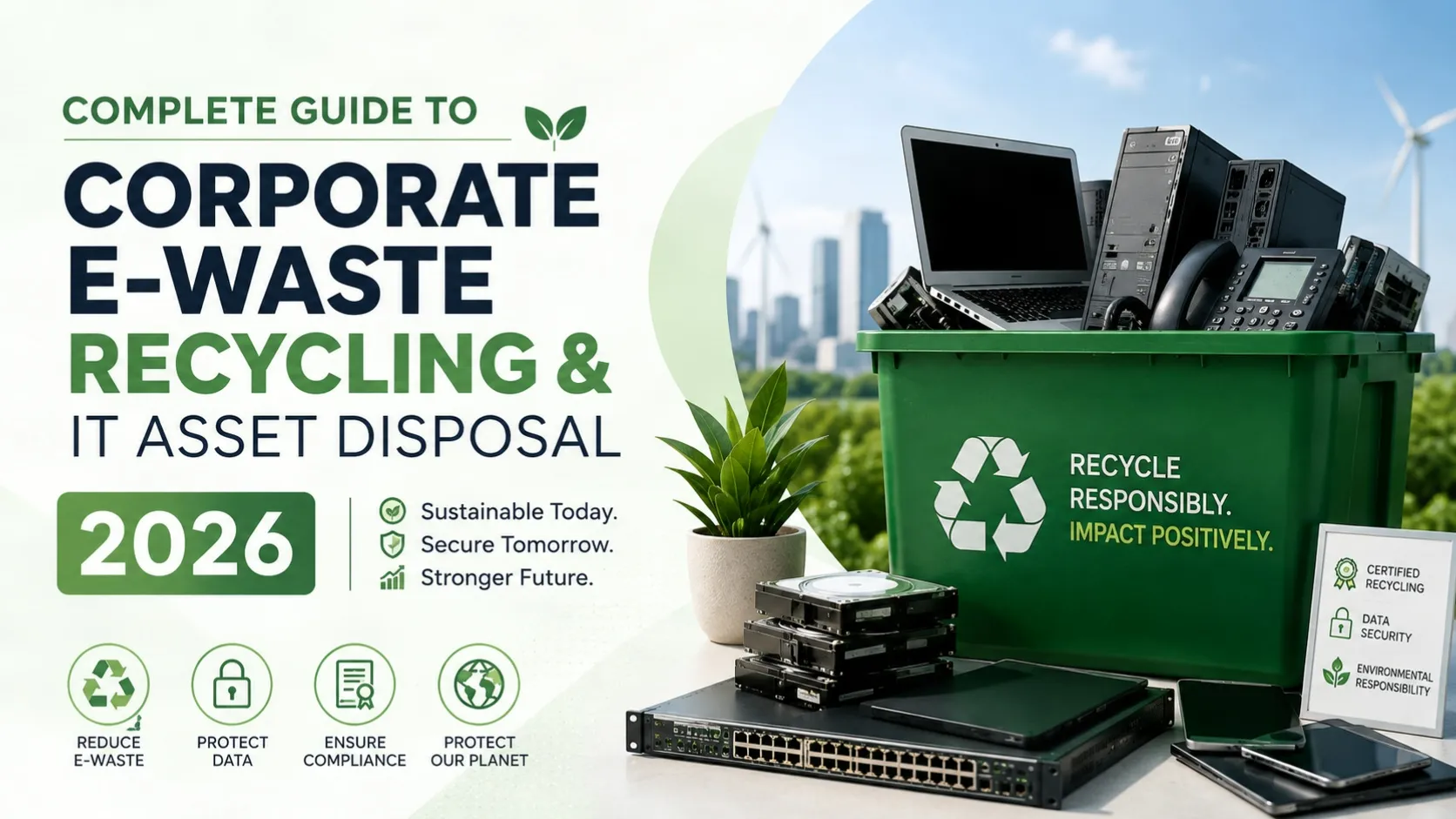
Most companies have a procurement process. Very few have an equally serious disposal process. That gap is where data breaches happen, where environmental liability accumulates, and where regulators are increasingly looking.
The numbers are stark. The world generated 62 million metric tonnes of e-waste in 2022. A fraction of it was formally recycled. The rest went to landfill, informal processors, or simply piled up in storage rooms where “we’ll deal with it later” became a permanent policy.
For businesses, the consequences of that gap are no longer theoretical. Fines for improper disposal are real. Data recovered from improperly retired devices is a documented attack vector. ESG reporting requirements are making sustainability practices visible to investors in ways they weren’t five years ago.
This guide is written for IT managers, compliance officers, and operations leads who need a clear, practical picture of what responsible corporate e-waste management looks like — and what it costs you when it’s done wrong.
What is Corporate E-Waste — and Why It’s Different From Consumer Recycling

When a consumer drops an old phone at a retail collection point, the main concerns are environmental. When a business retires 500 laptops, a server room, or a telecoms infrastructure stack, the concerns are environmental, legal, financial, and security-related — simultaneously.
Enterprise e-waste is defined by volume, data sensitivity, and compliance obligation. A single decommissioned server may contain multiple storage drives holding years of financial records, customer data, or intellectual property. A retired firewall retains network credentials and configuration data. A fleet of returned employee laptops represents hundreds of individual data risks if not properly processed.
The devices businesses need to manage at end of life span a wide range:
| Device Type | Examples | Primary Risk |
| Computers & Workstations | Laptops, desktops, thin clients | Employee and customer data |
| Servers & Storage | Rack servers, NAS, SANs, tape drives | Large-volume sensitive data |
| Networking Equipment | Routers, switches, firewalls | Credentials and network configuration |
| Telecom Hardware | PBX systems, comms infrastructure | Call logs and voicemail records |
| Office Electronics | Printers, scanners, monitors, UPS units | Cached documents and access credentials |
| Mobile Devices | Smartphones, tablets, handheld terminals | Personal and business account data |
| Industrial Electronics | PLCs, control panels, automation systems | Proprietary process and operational data |
Industries with the highest volumes and strictest obligations include healthcare, financial services, telecoms, manufacturing, government, and education. But any business handling personal data — which in practice means nearly every business — has legal obligations that apply the moment a device is retired.
What’s Actually at Risk When You Get This Wrong
Data Doesn’t Disappear When You Delete It
This is the point that still catches businesses off guard. Deleting files, wiping a device through the operating system, or performing a factory reset does not destroy data. Forensic recovery tools — many of them freely available — can retrieve data from drives that have been “wiped” through standard means.
Security researchers have demonstrated this repeatedly. Hard drives purchased on secondary markets have yielded patient records from hospitals, financial data from banks, and login credentials from corporate networks. In each case, the originating organization believed the data had been cleared.
For businesses, the liability exposure from a breach traced back to improperly disposed equipment is significant: regulatory investigation, mandatory customer notification, civil litigation, and in regulated sectors, potential criminal liability for senior officers.
The Compliance Landscape Is Getting Stricter
GDPR treats failure to properly destroy personal data at end of life as a compliance violation under the storage limitation and security requirements of Article 5 and Article 32. HIPAA requires healthcare organizations and their business associates to certify the destruction of electronic protected health information. The UAE’s Federal Law No. 24 and Dubai’s sustainability frameworks impose environmental handling requirements on businesses operating in the region.
These aren’t abstract obligations. They are enforced, and regulators in multiple jurisdictions have demonstrated willingness to pursue businesses that cannot document what happened to retired devices containing personal data.
The Financial Cost of Doing Nothing
Beyond the liability exposure, poor IT asset disposal is simply bad asset management. Functional equipment discarded rather than remarketed represents direct financial loss. A three-year-old enterprise laptop, properly wiped and refurbished, still has market value. Servers, networking hardware, and storage equipment often retain meaningful residual value well past the point businesses typically replace them.
The materials inside the devices have value too. Gold, copper, aluminum, and rare earth elements are recoverable and feed back into manufacturing supply chains. A certified recycler with material recovery capabilities can offset a portion of your disposal costs through what’s recovered.
How Corporate E-Waste Recycling Actually Works
Understanding the process matters because the quality of execution at each stage directly affects your security, compliance, and financial outcomes.
Collection and Transportation Professional enterprise recyclers provide scheduled pickups with signed collection documentation. Every item leaving your premises should be logged with a unique identifier before it moves. Tracked transportation with documented chain of custody is non-negotiable — the moment you lose visibility over where equipment is, your compliance position weakens.
Asset Auditing and Inventory On arrival at the processing facility, every device is inventoried: device type, make, model, serial number, condition. This record is the backbone of your compliance documentation and the basis for any remarketing assessment. Good recyclers can integrate with your internal asset management systems to provide a clean audit trail from retirement to final disposition.
Segregation and Classification Equipment is sorted by end-of-life pathway. Functional devices are assessed for refurbishment. Devices beyond economic repair go to material recovery. Hazardous components — batteries, screens containing mercury, certain capacitors — are separated for specialist handling. This stage determines the most environmentally and financially optimal outcome for each device.
Secure Data Destruction This is where most businesses should be paying closest attention.
| Method | How It Works | Best For | Assurance Level |
| Software Wiping | Overwrites storage to NIST 800-88 or DoD 5220.22-M standards | Devices being remarketed or donated | High — certified and auditable |
| Degaussing | Magnetic field exposure renders media unreadable | HDDs and magnetic tape only | High — device unusable after |
| Physical Shredding | Industrial destruction of the drive | Sensitive, classified, or high-risk data | Absolute — recovery impossible |
Every destruction event should produce a device-level Certificate of Data Destruction. Not a batch summary — individual records for each device. This is what your legal, compliance, and data protection teams need, and it’s what regulators will ask for.
Material Recovery Once data is destroyed, materials are extracted and processed. The recoverable value in electronics is significant and consistently underappreciated. A tonne of circuit boards yields more gold per kilogram than most commercial gold ores. Copper, aluminum, palladium, silver, and rare earth elements all have real market value. Responsible material recovery keeps these resources in productive use rather than losing them to landfill.
Compliance Documentation The final deliverable is a complete documentation package: data destruction certificates, recycling completion report, material weight summaries, and evidence of processing under certified standards. This is what goes into your ESG report, your regulatory file, and your response to the next supplier audit that asks about your IT disposal practices.
Compliance, Certifications, and What the Regulations Actually Require
The regulatory environment around e-waste spans environmental law, data protection, and in some sectors, industry-specific security standards. Businesses typically have obligations under multiple frameworks simultaneously.
The Basel Convention governs international movement of hazardous waste including electronics. EU WEEE Directive places producer responsibility on businesses. GDPR, HIPAA, and their equivalents in other markets create data destruction obligations. The UAE’s environmental framework and Dubai’s sustainability initiatives set regional requirements for businesses operating in the Gulf.
When evaluating a recycling partner, these certifications matter:
- ISO 14001 — Environmental management systems. Confirms the recycler manages environmental impact systematically.
- R2 Certification — The leading global standard for electronics recyclers. Covers security, environmental handling, worker safety, and downstream accountability.
- ISO 27001 — Information security management. Essential for any partner handling data-bearing devices.
- ISO 45001 — Occupational health and safety. Relevant because e-waste processing involves genuinely hazardous materials.
Ask for current certificates. A certification that lapsed two years ago tells you nothing about current practice.
The Business Case for Circular Economy Thinking in IT Disposal
The most sophisticated enterprise IT disposal programs aren’t just recycling — they’re managing assets across their full lifecycle with recovery and reuse built in from the start.
Refurbishment and remarketing should be the default consideration for any functional device. Enterprise hardware refreshes often retire equipment that’s three to five years old and still commercially viable. Properly wiped and refurbished, these devices generate financial returns that partially or fully offset disposal costs — and extend the useful life of the hardware by several more years before it eventually reaches material recovery.
When equipment does reach end of life, the materials inside it have genuine value. The UN estimates the raw material value of global e-waste at over $57 billion annually. The majority is lost because equipment isn’t properly processed. For businesses, working with a recycler that maximizes material recovery means contributing to that value rather than writing it off.
This approach — prioritizing reuse, then recovery, then responsible disposal — is what circular economy principles look like in practice for corporate IT asset management.
How to Evaluate a Corporate E-Waste Recycling Partner
| Evaluation Factor | What Good Looks Like | Warning Signs |
| Certifications | Current ISO 14001, R2, ISO 27001 certificates | Expired, unverifiable, or claimed without documentation |
| Data Destruction | Device-level certificates for every asset | Batch summaries or no documentation offered |
| Chain of Custody | Signed collection docs, tracked transport, facility intake records | No tracking, unsigned pickups, vague logistics |
| Downstream Transparency | Named downstream vendors, no informal channels | Reluctance to disclose where materials go |
| Reporting Quality | Audit-ready reports with material weights and device records | Minimal reporting, only available on request |
| Enterprise Experience | Documented work with comparable organizations | Consumer operation applied to enterprise volumes |
| Geographic Capability | Multi-site and international pickup coverage | Single-location capability only |
One question worth asking directly: “Can you show me a sample compliance report package?” A credible recycler will hand one over without hesitation. One that hedges or deflects is telling you something important.
Why Choose Reloop Global for Corporate E-Waste Recycling
Most companies will collect your old IT equipment. Far fewer can tell you exactly what happened to every device after it left your building — and prove it with documentation that holds up in a compliance audit.
We are built for enterprise. Our logistics, security protocols, and reporting are designed specifically for business clients — not adapted from a consumer recycling model.
We are independently certified across every standard your compliance and legal teams will ask about — ISO 9001:2015, ISO 14001:2015, ISO 45001:2018, and ISO/IEC 27001:2022. All current. All subject to annual surveillance audits.
We destroy data properly. Every device receives certified destruction — wiping, degaussing, or physical shredding — with individual device-level certificates of destruction issued on completion. Not batch summaries. Individual records.
We track everything. Signed collection at pickup, GPS-monitored transport, facility intake records, and final disposition documentation for every asset. Full chain of custody, start to finish.
We give you reporting you can actually use. Every engagement closes with a complete documentation package — ready for ESG disclosures, regulatory submissions, and audit files without additional work on your end.
We know the region. Based at Jebel Ali Freezone Authority, Dubai, we understand the UAE and Gulf regulatory environment — and serve multinational clients with the same certified standards across international locations.
Conclusion
The businesses that handle corporate e-waste well aren’t doing it out of altruism. They do it because the alternative — data breaches from retired devices, regulatory penalties for improper disposal, ESG reporting gaps, and missed asset recovery value — costs more than getting it right.
A proper IT asset disposal program is, at its core, an extension of the same risk management discipline that governs every other aspect of how a responsible business operates. The equipment leaving your building contains data, materials, and liability. Managing that properly requires a certified partner with documented processes, genuine transparency, and the reporting capability to give your compliance and sustainability functions what they need.
Reloop Global works with enterprise clients across healthcare, telecoms, government, manufacturing, and financial services to make that process straightforward, documented, and fully compliant — wherever their equipment is located.
Frequently Asked Questions
Que: How do we know data is actually destroyed and not just claimed to be?
Ans: The certificate of data destruction should include the device serial number, the destruction method used, the date, and the name of the certified technician or facility. It should be signed and issued on the recycler’s letterhead. If you’re receiving a one-page summary for 500 devices with no individual records, that’s not adequate documentation.
Que: Can we recover any value from retired equipment?
Ans: Often yes, and more than most businesses expect. Enterprise laptops, servers, and networking hardware have active secondary markets. A good ITAD partner will assess incoming equipment, route viable devices to remarketing, and provide transparent accounting of what was recovered and at what value.
Que: How often should we be running disposal programs?
Ans: At each hardware refresh cycle rather than letting retired equipment accumulate. Most businesses refresh end-user devices every three to five years; server and infrastructure equipment on longer cycles. Irregular large-volume disposals are harder to manage, harder to document, and often less financially efficient than regular scheduled programs.
Que: What if we operate across multiple countries?
Ans: You need a partner with genuine international capability and knowledge of local regulatory requirements — not one that manages collection in your headquarters country and outsources everything else to unknown local operators. Ask specifically about how compliance documentation is consolidated across jurisdictions.

Raju Lajwani
 Connect on LinkedIn