We deal with plastic waste every single day. Warehouses in Jebel Ali stacking bales of stretch film in the yard because nobody arranged a collection. Food manufacturers sending perfectly recyclable PP packaging to landfill because it had a food label on it. Hospitals stockpiling PPE waste with no clear route for disposal.
This is the reality of commercial plastic waste in the UAE. It is not a knowledge problem – most operations managers know recycling matters. It is a systems problem. And it is one that costs businesses money, compliance standing, and time they do not have.
This guide is written from the field. It covers what actually works, what the regulations require, and what to expect when you set up a proper commercial recycling programme in the UAE.
What Is Plastic Waste Recycling?
It Is Not What Households Do
When people think about recycling, they think about putting a bottle in a blue bin. Commercial plastic recycling is a different operation entirely.
A warehouse generating 20 tonnes of stretch film a month needs scheduled collections, on-site compaction, and a processing partner who can handle film – not a general waste contractor who will mix it with general refuse and charge a disposal fee. A pharmaceutical company needs documented chain of custody and recycling certificates for its ESG reports. A food manufacturer needs a partner who understands food-contact contamination and does not reject entire loads because of residue on two containers.
The distinction between consumer and commercial recycling is not just scale. It is compliance, documentation, logistics, and specialist processing – none of which matter to households the way they matter to businesses.
Why UAE Businesses Are Taking It Seriously Now
Three things have changed in the last few years.
Regulations now have consequences. Dubai Municipality and emirate-level authorities are enforcing commercial waste requirements more actively. Operating without licensed waste contractors is a genuine risk, not a technicality.
ESG reporting has moved from PR to governance. Listed companies face disclosure requirements. International investors require documented environmental performance. Large buyers – particularly multinationals in retail and FMCG – are auditing suppliers on waste metrics.
The cost of doing nothing has gone up. Landfill disposal costs are rising. Businesses generating large volumes of recyclable plastic and sending it to landfill are paying to throw away material that has real commercial value.
Plastics Your Business Is Probably Generating
| Plastic Type | Resin Code | Common Sources | Recyclability |
|---|---|---|---|
| PET | #1 | Bottles, food trays, packaging | High value |
| HDPE | #2 | Drums, containers, pipes | High value |
| LDPE | #4 | Stretch film, bags, bubble wrap | Recyclable – needs specialist processing |
| PP | #5 | Packaging, medical items, automotive parts | High value |
| PVC | #3 | Pipes, cable insulation | Limited |
| PS | #6 | Foam packaging, disposables | Difficult at scale |
The type businesses most commonly get wrong is LDPE film – stretch wrap, shrink film, carrier bags. These are absolutely recyclable but cannot go through the same process as rigid plastics. They need densification before transport and a processor specifically set up for film. Most general waste contractors are not.
How the Recycling Process Actually Works
The recycling process has six stages. What happens at each stage determines the quality and value of the end product.
| Stage | What Happens | What Affects It |
|---|---|---|
| Collection | Scheduled pickup from your site | Volume, storage, segregation |
| Sorting | Material separated by resin type | How clean and separated it arrives |
| Cleaning | Washed to remove contamination | Food residue, labels, moisture |
| Shredding | Reduced to uniform flakes | Plastic type and thickness |
| Pelletizing | Melted and extruded into pellets | Input quality |
| Manufacturing | Pellets sold to product manufacturers | Pellet grade |
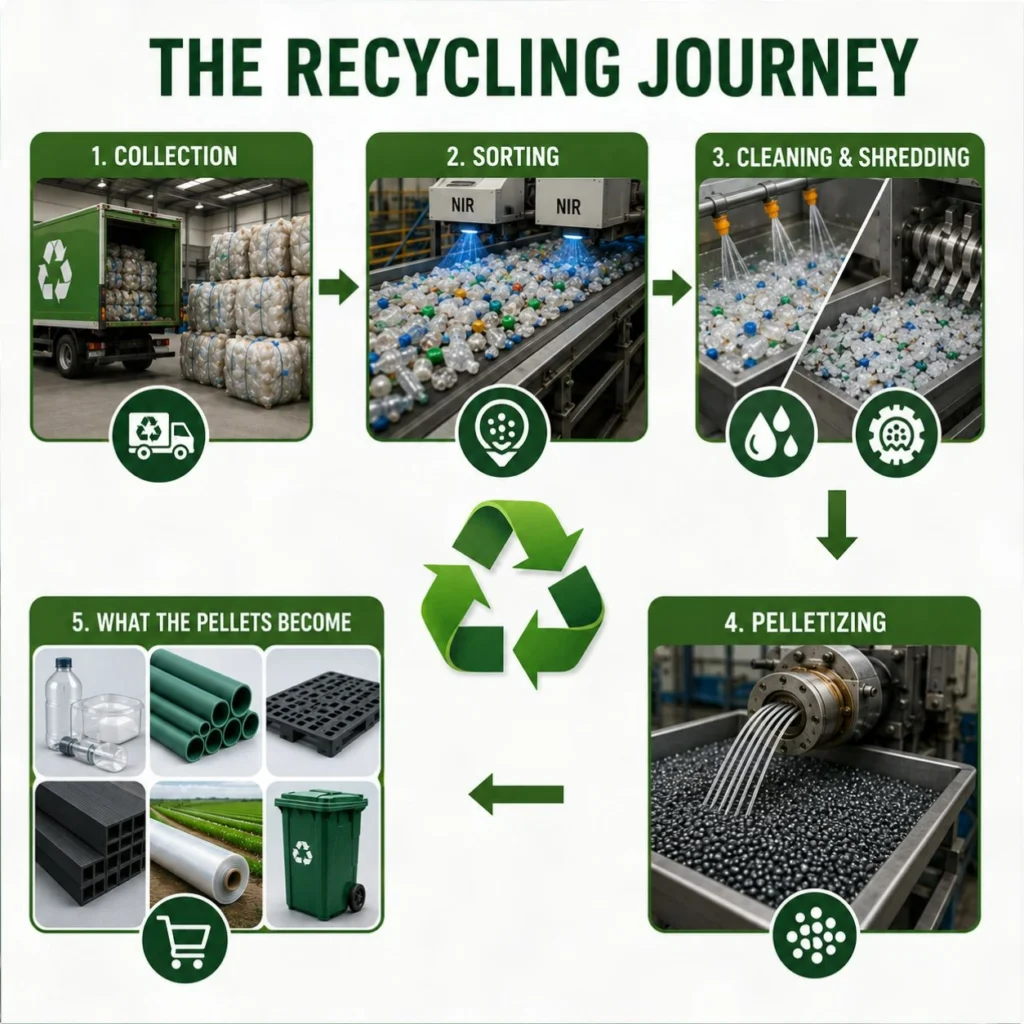
Collection
The most common question we get is about collection frequency. The honest answer is that it depends entirely on your volume and storage situation. A warehouse generating several tonnes of stretch film a week needs a different arrangement than a retail outlet with a few hundred kilograms a month.
What matters operationally is clean, dry storage, proper segregation from general waste, and internal ownership of the process. Collections that get missed or cancelled are almost always a sign that nobody on-site is accountable for making it happen.
Businesses that bale their plastic on-site consistently get better economics. A baler pays for itself faster than most people expect when you factor in reduced collection frequency and better material rates.
Sorting
Once material arrives at the facility, it is sorted by resin type using near-infrared (NIR) optical systems that identify plastic grades faster and more accurately than manual sorting. Good source segregation on your end reduces processing costs and returns better value. Mixed loads cost more to handle, generate more rejects, and produce lower-grade output.
Cleaning and Shredding
Plastics are washed to remove food residue, labels, adhesives, and contaminants, then shredded to uniform flakes. The cleaner the input, the higher the output grade. This is why we work specifically on segregation with new clients during onboarding – it directly affects what comes out the other end.
Pelletizing
Shredded, clean plastic is melted and extruded into pellets – the end product that manufacturers buy in place of virgin plastic. Quality varies significantly. The best recycled HDPE pellets from clean industrial scrap are close to virgin specification. Pellets from contaminated mixed streams are lower grade and suit less demanding applications.
What the Pellets Become
Pellets go to manufacturers making packaging, construction products, plastic lumber, pallets, agricultural film, and industrial products. Demand from UAE manufacturers has grown considerably, driven by FMCG brand commitments to recycled packaging and cost pressure as virgin plastic prices fluctuate.
Types of Plastic Waste Businesses Generate
| Waste Type | Common Materials | Condition | Recyclability |
|---|---|---|---|
| Packaging and film | Stretch film, shrink wrap, bubble wrap | Variable – clean to contaminated | High when clean and baled |
| Industrial scrap | Manufacturing offcuts, production rejects, plastic drums | Usually clean and single-type | High – often close to virgin spec |
| Medical plastics | PPE, IV bags, pharmaceutical packaging | Specialist handling required | Yes – with approved partner only |
| Agricultural plastics | Irrigation pipes, mulch films, fertilizer bags | Dirty – soil, chemicals, moisture | Yes – after pre-cleaning |
| E-waste plastics | Mixed polymers from electronics | Complex, potentially hazardous | Specialist processing only |
Packaging and film leads on volume. Industrial scrap leads on value per tonne – it is typically the cleanest material we receive. Medical and agricultural waste both require specialist handling; a general recycler is not the right partner for either.
What UAE Regulations Actually Require
The Baseline Requirements
Commercial waste in the UAE must be handled by licensed contractors. Businesses are required to segregate waste at source and maintain records. High-volume generators may need formal waste management plans. Free zones – JAFZA, DMCC, and others – add their own requirements on top of emirate-level rules.
Fines apply for illegal disposal, contamination of shared waste streams, and failure to use licensed contractors. Enforcement has been moving in one direction for several years.
UAE Sustainability Targets
The UAE Net Zero by 2050 commitment and Waste Management Vision 2030 translate into commercial pressure through procurement criteria, regulatory direction, and investor expectations. Businesses tendering for government contracts, seeking international investment, or supplying to multinational brands increasingly need to demonstrate documented sustainability performance. Plastic waste management is a visible and measurable part of that.
ESG in Practice
We regularly work with businesses that came to us specifically because they failed a supplier audit on waste management. Not because they were doing something illegal – because they had no documentation. The auditor asked for recycling certificates and diversion rates. They had neither. That cost them a contract.
The Securities and Commodities Authority has sustainability disclosure requirements for listed companies. International investors applying ESG frameworks require documented waste diversion data. Supply chain auditors from FMCG multinationals include recycling rates in their assessments. This is the level the conversation has moved to.
Recycling Methods and When to Use Each
| Method | How It Works | Best For | Limitations |
|---|---|---|---|
| Mechanical recycling | Shred, wash, melt, pelletize | Clean, single-type plastics (HDPE, PET, PP, LDPE film) | Cannot handle mixed or heavily contaminated loads |
| Chemical recycling | Break plastic to molecular level using heat or chemicals | Mixed, contaminated, or food-contact plastics | More expensive; still scaling commercially |
| Energy recovery | Controlled combustion to generate heat and electricity | Non-recyclable residual fractions | Not circular; landfill is worse, but this is not the goal |
| Closed-loop recycling | Waste becomes your own raw material | High-volume, consistent streams | Requires volume and a willing processing partner |
Mechanical recycling is the right route for the majority of commercial plastic waste when material is properly segregated. Chemical recycling is advancing rapidly and is increasingly relevant for businesses with complex waste profiles. Closed-loop is the most commercially elegant option at sufficient scale – several major UAE operations have moved to this model and the number is growing.
Equipment That Changes the Economics
| Equipment | What It Does | Who Needs It |
|---|---|---|
| Baler | Compresses plastic into dense bales | High-volume generators – warehouses, distribution centres |
| Densifier | Partially melts and compacts film into dense blocks | Any operation generating significant stretch film or carrier bags |
| Granulator | Fine size reduction; recovers manufacturing scrap inline | Manufacturing operations with plastic offcuts |
| Shredder | Reduces bulky plastic – drums, pipes, pallets | Operations with large or rigid plastic waste |
| Extruder | Melts and pelletizes processed plastic | Processing facilities, not typically on-site |
On-site equipment is not right for every operation. The volume needs to justify the investment. Part of what we do at Reloop Recycling FZE is assess whether on-site equipment makes sense for a given client – or whether scheduled collection is the better model.
What Goes Wrong and Why
Most recycling programme failures come down to the same four problems.
Contamination causes more failures than anything else. It is almost never a fundamental problem – it is a training and systems failure. Clear labelling, dedicated containers, and consistent reinforcement fix the majority of contamination issues. It needs someone to own it.
Film economics without compaction do not work. Loose stretch film is cheap to generate and expensive to collect and transport. The maths only works with compaction. If your recycling partner is collecting loose film without densification equipment, the arrangement will not hold commercially.
Mixing plastic types at source creates low-grade mixed loads that are worth less and may be rejected entirely. Segregation matters most at the point where waste is generated – once it is mixed, separation is expensive and often incomplete.
Choosing the wrong partner is the most costly mistake. A general waste contractor who accepts plastic waste but routes it to landfill is worse than useless. You are paying for a service you are not receiving and accumulating no documentation.
How to Run a Better Plastic Waste Programme
Start with a waste audit. You cannot manage what you have not measured. An audit tells you what you are generating, in what volumes, from which parts of the operation, and what is currently happening to it. The findings regularly surprise operations managers who assumed their recycling was working.
Implement segregation properly. One container per plastic stream, clearly labelled, positioned where the waste is generated. Review it after the first month and adjust based on what you find.
Train the people who actually handle the waste. Not the management team – the warehouse operatives, production floor staff, and cleaning teams. They are the ones whose behaviour determines whether the programme works.
Track the numbers monthly. Tonnes collected by material type, diversion rate from landfill, contamination rate, recycling certificates issued. Your recycling partner should provide this without you chasing it.
Choosing a Recycling Partner in UAE
| What to Check | What Good Looks Like | Red Flag |
|---|---|---|
| Licensing | UAE Ministry of Climate Change approval, Dubai Municipality or emirate-level licence | No licence documentation available |
| Reporting | Monthly reports with tonnage by type, recycling certificates, waste transfer docs | “We can provide that if you need it” |
| Processing transparency | Specific facility name, what it produces, where output is sold | Vague or evasive answers |
| Sector experience | Demonstrable experience in your industry and your plastic types | Generic claims with no specific examples |
| Collection reliability | Referenced by existing clients for on-time performance | No client references offered |
Ask any potential partner what happens to your waste after collection. A credible recycler can answer that question specifically. A vague answer is telling you something.
Where the Industry Is Heading
AI optical sorting is improving accuracy and throughput faster than most people in the industry expected five years ago. Chemical recycling is moving from pilot scale to commercial scale. The market for recycled plastic pellets is deepening as manufacturers commit to recycled content targets. UAE government investment in circular economy infrastructure is creating real processing capacity, not just policy statements.
The regulatory trajectory is equally clear – requirements are tightening, enforcement is increasing, and landfill costs are rising. Businesses with well-documented recycling programmes will be in a comfortable compliance position over the next five years. Businesses that have not started will be catching up while also managing growing costs and audit pressure.
The operations that are ahead of this are not necessarily the biggest. They are the ones where someone decided to treat plastic waste as a managed process rather than a disposal problem.
Conclusion
Commercial plastic waste recycling in the UAE is not a complex problem. It is a process problem. The right systems, the right partner, and internal accountability will produce results that satisfy regulators, satisfy ESG auditors, and reduce costs.
What does not work is treating it as an afterthought – arranging a collection when the yard is full, accepting whatever documentation a contractor provides without checking it, and assuming that because plastic waste is collected it is being recycled.
At Reloop Recycling FZE, we have built commercial recycling programmes for businesses across manufacturing, logistics, healthcare, retail, and construction in the UAE. We know what the regulations require, what the auditors look for, and how to build a programme that holds up under scrutiny.
If you want to know where your plastic waste currently stands – get in touch. We start with a waste audit, and the findings usually justify the conversation many times over.
Frequently Asked Questions
What is commercial plastic waste recycling?
The process of collecting, sorting, and reprocessing business-generated plastic waste into recycled raw materials. For UAE businesses, it includes licensed contractor requirements, chain of custody documentation, and recycling certification that supports ESG and regulatory reporting.
How does the recycling process work?
Collection from your site, sorting by resin type, washing to remove contamination, shredding to uniform flakes, extrusion into recycled pellets, and sale to product manufacturers. Quality at every stage depends on what goes in – segregated, clean material produces better output than mixed, contaminated loads.
Which plastics are hardest to recycle?
Multilayer films, black plastics, expanded polystyrene, and composite packaging that combines plastic with foil or paper. Chemical recycling handles many of these where mechanical recycling cannot.
Why does plastic recycling matter commercially?
Regulatory compliance, ESG reporting requirements, reduced disposal costs, potential material rebates, and supply chain sustainability criteria from buyers and investors. The commercial case is as strong as the environmental one.
How do UAE businesses get started?
Waste audit to understand your current position, licensed recycling partner for collection and processing, on-site segregation systems, and monthly reporting from your partner. None of it is complicated to set up with the right support.
What do recycled plastics get used for?
Packaging, construction materials, plastic lumber, pallets, agricultural film, industrial containers, and a growing range of manufactured products. End market demand for good-quality UAE recyclate is stronger now than at any point in the last decade.

Raju Lajwani
 Connect on LinkedIn