Fast-moving consumer goods companies generate waste at nearly every stage of their operations – from raw material intake to final delivery. As production volumes grow and packaging formats multiply, FMCG waste management for businesses has become a core operational concern rather than an afterthought. Manufacturers, distributors, warehouses, and retailers are all looking for practical ways to reduce waste, improve segregation, and recover more value from materials that would otherwise end up in landfill.
This shift is being driven by several converging pressures: rising packaging volumes, more complex supply chains, growing customer expectations around sustainability, and the simple economics of running a leaner operation. Businesses that treat waste as a resource to be managed – rather than a cost to be absorbed – tend to run more efficient, more resilient operations. Recycling partners play an important role in this shift, helping companies turn waste streams into structured, measurable programs.
For sustainability managers, operations managers, and supply chain leaders, the challenge is rarely a lack of intent – most FMCG businesses want to recycle more and waste less. The harder part is building processes that make this consistent across multiple sites, product lines, and teams, rather than relying on ad hoc efforts that vary from one facility to the next.
This guide walks through where FMCG waste typically originates, how to build stronger internal segregation processes, ways to reduce packaging waste across the supply chain, how returns and expired stock are best handled, and how to measure progress over time using clear, comparable metrics.
Understanding Waste Generated Across FMCG Operations
FMCG waste doesn’t come from a single source – it accumulates across the entire value chain. Recognizing where it originates is the first step toward managing it effectively.
Manufacturing waste typically includes production rejects, off-spec batches, plastic film, cartons, and pallets. Warehouse waste often consists of damaged packaging, torn cartons, and materials lost during handling or storage. Distribution waste includes transport packaging, shrink wrap, and secondary materials used to protect goods in transit. Retail returns add another layer – expired products, damaged goods, and packaging that no longer meets shelf standards.
Each of these waste streams carries a different recovery opportunity. Plastic film and cartons from manufacturing lines are often well suited to material recycling. Damaged packaging in warehouses can frequently be sorted and recovered rather than discarded outright. Transport packaging can often be reused or recycled depending on material type, and retail returns – particularly expired or damaged goods – may require secure destruction alongside responsible material recovery.
| Waste Source | Typical Materials | Common Recovery Opportunity |
| Manufacturing | Plastic film, cartons, pallets | Material recycling |
| Packaging Lines | Cardboard, shrink wrap | Recycling & baling |
| Warehouses | Damaged packaging | Recovery & sorting |
| Distribution | Transport packaging | Reuse & recycling |
| Retail Returns | Expired or damaged goods | Secure destruction & recovery |
Mapping waste sources this way gives operations and sustainability teams a clearer picture of where to focus improvement efforts first.
Building an Efficient Waste Segregation Process
Once the main waste streams are identified, the next step is building a segregation process that keeps materials clean, separated, and ready for recovery. Contamination – mixing recyclable and non-recyclable materials – is one of the most common reasons recyclable waste ends up in landfill instead of being recovered.
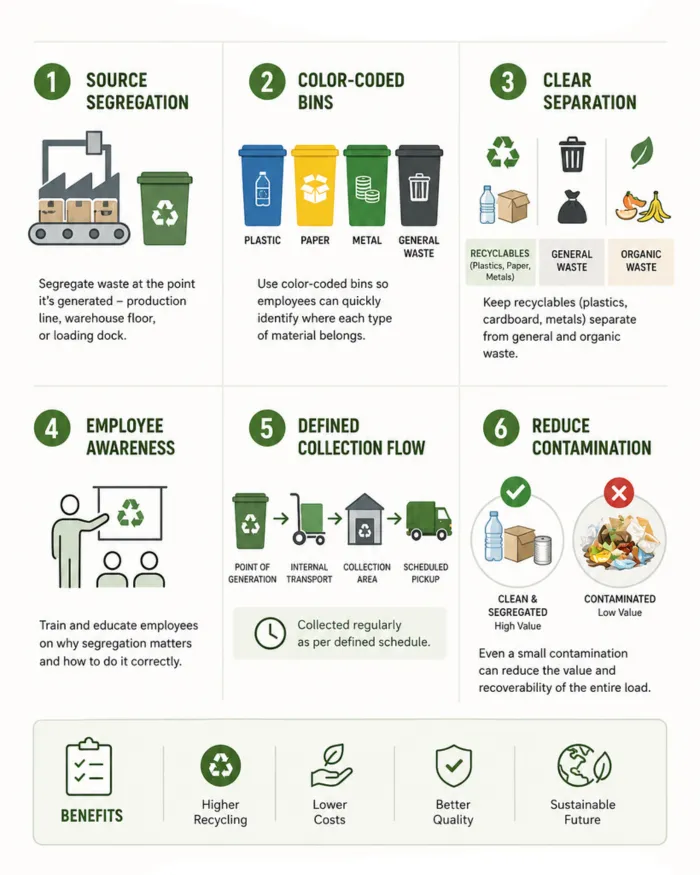
A practical segregation process usually includes:
- Source segregation, meaning waste is sorted at the point it’s generated (the production line, the warehouse floor, the loading dock) rather than after it has already been mixed.
- Color-coded bins so employees can quickly identify where different material types belong without needing to read detailed instructions each time.
- Clear separation of recyclables such as plastics, cardboard, and metals from general waste and organic waste.
- Employee awareness and training, since segregation only works consistently if the people generating the waste understand why it matters and how to do it correctly.
- A defined internal collection flow – how waste moves from the point of generation to a central collection area, and how often it’s picked up.
- Ongoing efforts to reduce contamination, since even a small percentage of incorrect material in a batch can affect the recoverability of the entire load.
Facilities that invest in this groundwork tend to see meaningfully higher recycling rates, simply because clean, well-sorted material is easier and more cost-effective for recycling partners to process.
In practice, this often means assigning clear ownership for waste segregation at each site – a shift supervisor or facilities lead who checks that bins are used correctly and that collection schedules are followed. Some facilities find it useful to run periodic audits of collected waste, spot-checking bins to see how much contamination is present and using that data to refine training or bin placement. Small adjustments, such as moving a recycling bin closer to a packing station or adding clearer signage at a busy intersection point, can meaningfully reduce the amount of recyclable material that ends up mixed with general waste.
Reducing Packaging Waste Across the Supply Chain
Packaging is one of the most visible and most addressable sources of waste in FMCG operations. Reducing it requires looking beyond the factory floor to the entire supply chain, from raw material sourcing to how products arrive on retail shelves.
Common approaches include:
- Packaging optimization – reviewing pack sizes, layers, and materials to eliminate unnecessary volume or weight without compromising product protection.
- Lightweight materials that reduce the total amount of packaging used per unit shipped, which also lowers transport-related material use.
- Reusable transport packaging, such as pallets, crates, and containers that can be cycled back into the system rather than discarded after a single use.
- Secondary packaging improvements, including reducing excess cardboard, plastic wrap, or filler material used to protect products in transit.
- Supplier collaboration, working with upstream partners to standardize packaging formats and reduce material variety, which in turn simplifies recycling downstream.
These changes often deliver a dual benefit: less material waste and lower packaging-related costs, since reduced material use typically translates into lower procurement and transport spend as well.
Many of these frameworks draw on the broader concept of the waste hierarchy – prioritizing reduction first, then reuse, then recycling, with disposal treated as a last resort. Organizations such as the Ellen MacArthur Foundation have popularized related circular economy principles, which encourage designing packaging and products with their eventual reuse or recovery in mind from the outset, rather than addressing waste only after it has already been generated.
Managing Expired, Damaged, and Returned Products
Product returns, expirations, and damage are an unavoidable part of FMCG operations, but how they’re managed has a direct impact on both brand protection and material recovery.
Key considerations include:
- Brand protection, ensuring expired or damaged branded goods don’t re-enter the market or end up in channels the company doesn’t control.
- Secure product destruction, which provides a controlled, verifiable way to retire products that can no longer be sold or donated.
- Inventory control, tracking why products are being returned or written off so patterns can be addressed at the source – whether that’s demand forecasting, packaging durability, or handling practices.
- Reverse logistics, the process of moving returned or expired goods from retail and distribution points back to a central facility for sorting, destruction, or recovery.
- Responsible material recovery, extracting reusable materials (such as packaging components) from products that are otherwise being retired.
A structured approach to this stage of the waste cycle reduces both operational risk and material loss, while giving sustainability teams better visibility into where returns and write-offs are concentrated.
The Role of Recycling Partners in Corporate Waste Management
Most FMCG businesses don’t manage recycling entirely in-house – they work with dedicated partners who handle collection, sorting, and material recovery at scale. A capable recycling partner typically supports:
- Collection across multiple sites, including manufacturing plants, warehouses, and distribution centers.
- Sorting of mixed waste streams into recoverable material categories.
- Material recovery, processing plastics, paper, cardboard, and metals into usable recycled inputs.
- Reporting support, providing data on volumes collected, recycled, and diverted from landfill.
- Scalable recycling programs that can expand as a business grows or adds new locations.
- Sustainability initiatives, helping companies align their waste management practices with broader environmental goals.
Working with an experienced partner also reduces the internal burden of managing waste logistics, allowing operations teams to focus on core production and distribution activities rather than the mechanics of recycling.
Measuring Waste Management Performance
Waste management improvements are only meaningful if they can be tracked over time. Businesses that treat this as an ongoing operational discipline – rather than a one-time initiative – tend to see steadier, more sustained progress.
Useful metrics include the total volume of waste generated, the volume successfully recycled, the diversion rate (the percentage of waste kept out of landfill), the contamination rate within collected material, and waste generated per unit of production.
| Operational Goal | Example KPI |
| Reduce landfill waste | Diversion Rate |
| Increase recycling | Recycling Volume |
| Improve segregation | Contamination Rate |
| Lower packaging waste | Packaging Reduction |
| Optimize operations | Waste per Production Unit |
Tracking these figures over time – ideally by site and by waste stream – helps operations and sustainability teams identify where programs are working and where additional attention is needed.
Many businesses also find it useful to benchmark performance against internal targets rather than industry-wide averages, since waste generation patterns can vary significantly depending on product type, packaging format, and facility size. A consistent internal baseline, measured quarterly or annually, often provides a clearer picture of progress than comparing across very different operations. Management frameworks such as ISO 14001 offer a broader structure for organizing environmental performance tracking, though businesses can adapt reporting practices to their own operational needs without necessarily pursuing formal certification.
Best Practices for FMCG Businesses
Bringing these elements together, a few consistent practices tend to separate businesses with mature waste management programs from those still building one:
- Improve waste segregation at the source, not after materials are already mixed
- Review packaging formats regularly rather than treating them as fixed
- Train warehouse and production teams on segregation and handling procedures
- Track waste trends over time, by site and by material type
- Optimize logistics to reduce transport packaging and material handling losses
- Partner with experienced recyclers who can scale alongside the business
- Monitor sustainability progress using consistent, comparable metrics
How Reloop Recycling FZE Supports FMCG Businesses
Reloop Recycling FZE works with manufacturers, distributors, warehouses, and retailers to build structured, scalable waste management programs suited to FMCG operations. Services include corporate recycling programs covering plastic, paper, and metal recovery, secure product destruction for expired or damaged goods, and reverse logistics support for returns moving back through the supply chain.
Beyond collection and material recovery, Reloop Recycling FZE supports multi-location businesses that need consistent processes across several sites, along with sustainability reporting that gives operations and sustainability teams clear visibility into recycling volumes and diversion rates. Recycling solutions are tailored to the specific waste streams and operational structure of each business, rather than applied as a one-size-fits-all program.
Conclusion
Effective FMCG waste management touches nearly every part of a business’s operations – from how materials are handled on the production line to how returns are processed and how packaging is designed. Businesses that build strong segregation processes, reduce unnecessary packaging, manage returns responsibly, and track performance consistently tend to see steady improvements in both recycling outcomes and operational efficiency.
Looking to improve your FMCG waste management strategy? Reloop Recycling FZE works with manufacturers, distributors, warehouses, and retailers to develop scalable recycling and material recovery solutions tailored to business operations.
FAQ
What types of waste are commonly generated in FMCG operations? FMCG operations typically generate waste across manufacturing (production rejects, plastic film, cartons), warehousing (damaged packaging), distribution (transport packaging), and retail (expired or damaged returns). Each stream has different characteristics and recovery potential.
How can businesses improve waste segregation? Improving segregation starts with sorting waste at the point it’s generated, using clearly labeled or color-coded bins, training employees on correct sorting practices, and establishing a defined internal collection flow that minimizes contamination between material types.
Why is packaging waste reduction important? Reducing packaging waste lowers material costs, simplifies recycling by reducing material variety, and decreases the overall volume of waste a business needs to manage across its supply chain.
What happens to damaged or expired products? Damaged or expired products are typically handled through secure destruction processes to protect brand integrity, combined with responsible recovery of any reusable packaging materials where possible.
How can recycling partners support FMCG businesses? Recycling partners provide collection, sorting, and material recovery services across multiple sites, along with reporting that helps businesses track recycling volumes, diversion rates, and overall program performance.

Raju Lajwani
 Connect on LinkedIn