Every retired laptop, server, and mobile device creates an environmental responsibility—not just electronic waste. As e-waste regulations tighten and ESG expectations grow, businesses must prove their IT assets are managed and recycled responsibly. ISO 14001 isn’t an e-waste recycling standard, but it provides the Environmental Management System (EMS) framework to identify, control, and continuously improve e-waste management. This guide explains how ISO 14001 supports e-waste compliance and the practical steps businesses in the UAE, GCC, USA, and India can take to build a sustainable, compliant recycling program.
What is ISO 14001?
ISO 14001 is the international standard for Environmental Management Systems (EMS). It gives organizations a framework to identify environmental impacts, meet legal obligations, and continually improve environmental performance – including how they manage waste, energy, and resources.
Published by the International Organization for Standardization, ISO 14001:2015 doesn’t tell a business exactly what to do. Instead, it asks a business to look honestly at its own operations, figure out where it affects the environment, and build a system to manage that impact over time.
That system applies to everything from water use and emissions to how a company deals with obsolete IT equipment.
What is an Environmental Management System (EMS)?
An Environmental Management System is a documented set of policies, processes, and controls an organization uses to manage its environmental responsibilities. It helps a business plan, monitor, and improve how it handles environmental risks such as waste, emissions, and resource consumption.
Think of an EMS as the operating manual for a company’s environmental behavior. It defines who is responsible for what, how risks are identified, how progress is measured, and how the organization corrects course when something isn’t working.
A mature EMS doesn’t sit in a binder. It shows up in daily decisions – like where old hard drives go when a data center is refreshed, or who signs off before a pallet of dead monitors leaves the building.
Benefits of ISO 14001
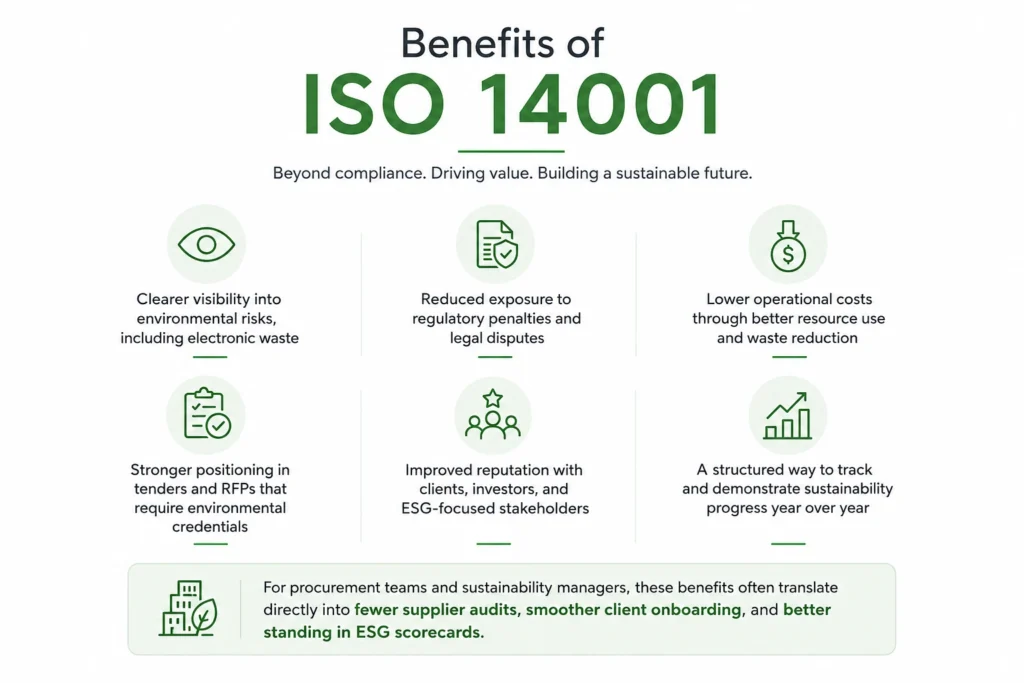
Businesses that implement ISO 14001 seriously tend to see benefits well beyond compliance paperwork:
- Clearer visibility into environmental risks, including electronic waste
- Reduced exposure to regulatory penalties and legal disputes
- Lower operational costs through better resource use and waste reduction
- Stronger positioning in tenders and RFPs that require environmental credentials
- Improved reputation with clients, investors, and ESG-focused stakeholders
- A structured way to track and demonstrate sustainability progress year over year
For procurement teams and sustainability managers, these benefits often translate directly into fewer supplier audits, smoother client onboarding, and better standing in ESG scorecards.
Why ISO 14001 Matters for E-Waste Management
ISO 14001 matters for e-waste because electronic waste is one of the fastest-growing and most hazardous waste streams a business generates. The standard requires organizations to identify e-waste as an environmental aspect, understand its risks, and manage it through controlled, documented processes.
Electronic devices aren’t just “office junk.” Laptops, servers, and mobile phones contain materials like lead, mercury, cadmium, and lithium – all of which can cause real environmental harm if they end up in a landfill or are handled by unlicensed scrap dealers.
Under ISO 14001, an organization is expected to recognize this risk rather than treat old electronics as an afterthought. That means:
- Identifying e-waste generated across offices, warehouses, and data centers
- Understanding the hazardous components inside common devices
- Staying current on local environmental laws that govern e-waste disposal
- Documenting how e-waste is collected, stored, transported, and recycled
- Having a plan in place for accidents – a leaking battery or a damaged monitor, for example
It’s worth being precise here: ISO 14001 does not mandate a specific recycling method or a specific vendor. It requires the organization to set operational controls appropriate to its own risks and legal obligations. How a company meets that requirement – through in-house processes or a certified recycling partner – is up to the business.
How ISO 14001 Supports Sustainable Electronics Recycling
An EMS built around ISO 14001 principles gives sustainable electronics recycling a structure it usually lacks in ad-hoc setups.
Instead of e-waste disposal happening whenever someone remembers to call a vendor, it becomes a scheduled, monitored activity with clear ownership. A few ways this plays out in practice:
Objectives replace guesswork. Rather than vaguely “trying to recycle more,” a company sets a measurable goal – say, diverting a defined percentage of retired IT assets from landfill within a year.
Procedures replace individual judgment calls. Employees don’t have to decide on the spot what to do with a broken monitor; there’s already a documented process for collection and handoff to an authorized recycler.
Monitoring replaces assumptions. Internal audits and periodic reviews check whether the e-waste process is actually working, not just whether it looks good on paper.
Continuous improvement replaces stagnation. When an audit uncovers a gap – like assets sitting in storage for months without tracking – the EMS requires the business to act on it.
This is also where reverse logistics becomes important. A well-run EMS depends on electronic waste actually reaching an authorized recycler, not just leaving the building. That’s a logistics and chain-of-custody problem as much as an environmental one, which is why many businesses now build IT asset reverse logistics into their environmental controls from the start.
Key ISO 14001 Requirements for Businesses
ISO 14001 is built around a handful of core requirements. None of them mention e-waste by name, but each one directly shapes how a business should treat retired electronics.
| ISO 14001 Requirement | Why It Matters for Businesses |
|---|---|
| Environmental Policy | Establishes sustainability goals |
| Compliance Obligations | Helps meet environmental regulations |
| Risk Assessment | Identifies environmental impacts |
| Employee Awareness | Encourages responsible waste handling |
| Monitoring & Audits | Measures environmental performance |
| Continuous Improvement | Supports long-term sustainability |
An environmental policy sets the intent – a public commitment that the company takes its environmental footprint seriously, including how it disposes of technology.
Compliance obligations push a business to actually track the laws that apply to it. In the UAE, for example, environmental regulations around waste handling have been tightening, and companies that haven’t reviewed the latest UAE recycling regulations risk falling behind without realizing it.
Risk assessment is where e-waste usually gets identified for the first time in many organizations. Once a business maps out its environmental aspects, obsolete IT hardware almost always shows up as a material risk – both environmentally and from a data security standpoint.
Employee awareness matters more than people expect. A well-written e-waste policy is useless if the person clearing out a storeroom doesn’t know which bin an old hard drive belongs in.
Monitoring and audits turn intentions into evidence – the kind of evidence that ESG reports and client due diligence questionnaires increasingly demand.
Continuous improvement keeps the whole system from going stale as device volumes grow and regulations change.
Common Types of Corporate E-Waste
Before a business can manage e-waste responsibly, it needs a clear picture of what actually counts as e-waste inside its own operations. It’s usually more than people expect.
| Equipment | Recommended Management |
|---|---|
| Laptops | Refurbishment or recycling |
| Desktops | Material recovery |
| Servers | Certified recycling |
| Hard Drives | Secure data destruction |
| Mobile Devices | Precious metal recovery |
| Printers | Plastic and metal recycling |
| Network Equipment | Component recovery |
| UPS Systems | Battery recycling |
Laptops and desktops are the most visible category, but they’re often the easiest to manage well because they have clear resale or refurbishment value. A detailed breakdown of these categories is covered in our guide on types of e-waste and in a related look at devices that become e-waste as they reach end of life.
Servers and network equipment deserve particular attention. They tend to hold sensitive corporate data, and mishandling them creates both an environmental and a security exposure – a topic explored further in our piece on enterprise server recycling.
Hard drives are their own category entirely. Recycling the casing without properly destroying the data inside defeats the purpose – which is why secure data destruction has to happen before any material recovery step.
Best Practices for Managing E-Waste Under ISO 14001
Businesses that implement this well tend to follow a fairly consistent sequence:
- Conduct an environmental review of existing IT assets – what devices exist, where they are, and how old they are.
- Audit disposal practices currently in place, even informal ones, to see what’s actually happening versus what policy says should happen.
- Set measurable objectives, such as reducing landfill disposal or increasing the reuse rate of retired hardware.
- Train employees on how to identify, store, and hand off e-waste correctly, including hazard awareness for batteries and screens.
- Monitor performance through internal audits, recycling volume tracking, and management reviews.
- Improve continuously, adjusting the process as regulations shift or as the business scales.
These steps show up constantly in real business scenarios. An office relocation, for instance, often surfaces years of unmanaged e-waste sitting in storage closets. A data center hardware refresh can generate hundreds of decommissioned servers in a single quarter. A routine laptop replacement cycle, done without a documented process, can quietly become a data security incident waiting to happen.
Our corporate e-waste recycling guide walks through how to build a repeatable collection and disposal process that fits naturally into an ISO 14001-aligned EMS, whether the trigger is a planned refresh or an unplanned office move.
ISO 14001 and the Circular Economy
ISO 14001 supports the circular economy by pushing organizations to think beyond disposal and toward reuse, refurbishment, and material recovery. Rather than treating e-waste as pure waste, a circular approach treats it as a resource that can be recovered, resold, or reintegrated into the supply chain.
This shift matters more than it sounds. A laptop that’s refurbished and resold avoids the environmental cost of manufacturing a replacement from raw materials. A server stripped for functioning components reduces demand on new component production. Even devices that can’t be reused still contain recoverable metals – copper, aluminum, gold, and rare earth elements – that don’t need to be mined again if they’re recovered properly.
An EMS built on ISO 14001 principles naturally pulls a business toward this thinking, because “continuous improvement” almost always means finding better uses for what used to be thrown away.
This is also where asset recovery becomes a genuine financial consideration, not just an environmental one. Retired IT equipment that still has resale or component value can offset the cost of new purchases – turning a disposal line item into a partial recovery of capital.
Challenges Businesses Face Without ISO 14001
Companies without a structured EMS tend to run into the same problems, regardless of industry:
Lack of inventory tracking. Nobody has a clear list of how many devices exist, where they are, or when they’re due for replacement – which makes responsible disposal almost impossible to plan.
Improper storage of obsolete electronics. Old equipment piles up in storerooms or warehouses with no environmental controls, sometimes for years, creating both fire and leakage risks.
Data security concerns. Devices leave the building – through resale, donation, or disposal – without any verification that the data on them was properly destroyed.
Regulatory compliance risk. As e-waste rules tighten across the UAE, GCC, and other markets, businesses without documented processes are exposed to fines and reputational damage.
Environmental liability. If e-waste ends up with an unlicensed handler and causes contamination, the originating business can still be held responsible.
Missed refurbishment and recovery value. Without a system in place, usable equipment often gets scrapped or discarded rather than resold or repurposed – leaving money and materials on the table.
Secure disposal challenges are especially acute with laptops, since they travel between employees, departments, and sometimes countries before reaching end of life. Our guide on secure laptop disposal covers this in more depth.
How Reloop Recycling FZE Helps Businesses Manage E-Waste Responsibly
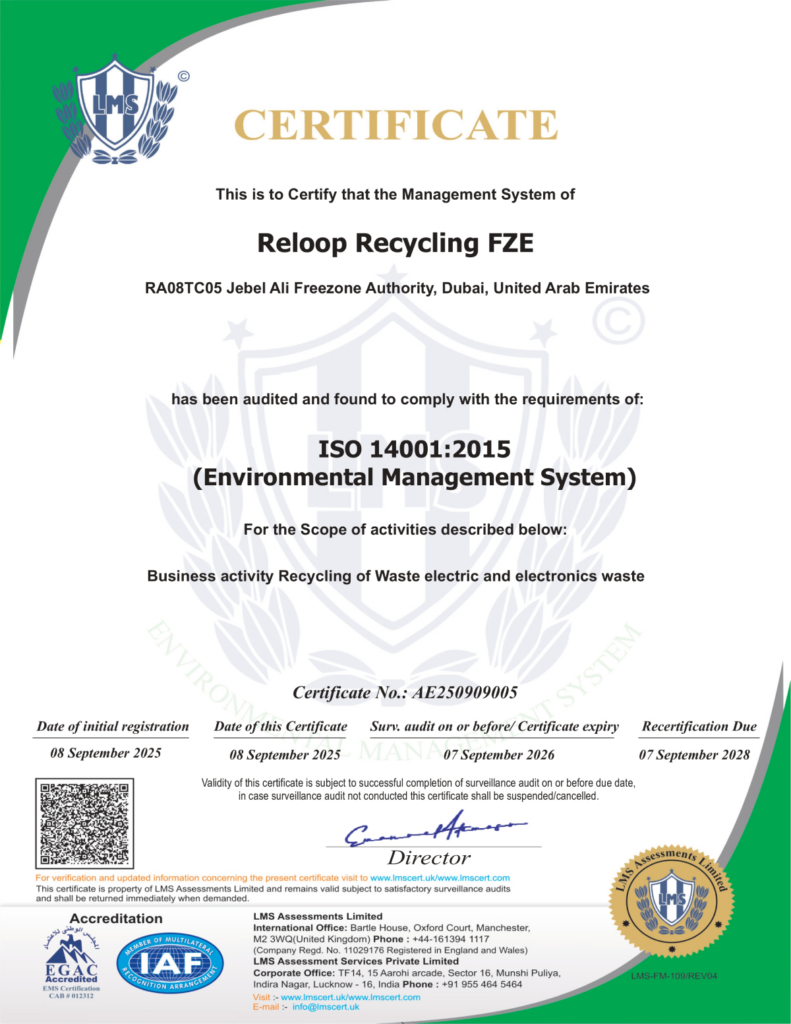
Meeting ISO 14001’s expectations around e-waste isn’t something most IT or facilities teams can do entirely in-house. It usually requires a recycling partner that understands both the environmental and the security side of end-of-life electronics.
Reloop Recycling FZE works with businesses across the UAE and wider region on exactly this kind of support, covering:
Corporate E-Waste Recycling – structured collection and recycling programs for retired laptops, desktops, servers, and networking equipment, designed to fit into a company’s broader environmental controls.
IT Asset Disposition (ITAD) – managing the full lifecycle of retired IT assets, from inventory and assessment through resale, refurbishment, or certified recycling, so nothing leaves the business untracked.
Secure Data Destruction – ensuring that hard drives and storage media are wiped or physically destroyed before any material recovery step, closing the data security gap that worries most IT managers.
Reverse Logistics – handling the transport and chain-of-custody of e-waste from offices, data centers, or warehouses to certified processing facilities, which supports the documented handling procedures ISO 14001 expects.
Asset Recovery – identifying equipment that still holds resale or component value, so businesses can recover part of their original investment instead of scrapping everything outright.
If your organization is building or refining an EMS, working with an experienced e-waste and ITAD partner like Reloop Recycling FZE can help translate policy language into an actual, auditable process – one that holds up whether it’s a routine AI hardware recycling project involving GPU servers, or a one-off office cleanout.
Note: Reloop Recycling FZE’s role here is as an operational recycling and ITAD partner. Businesses should independently verify any certification claims – including ISO 14001 status – of any vendor they work with, including Reloop, before relying on them for compliance purposes.
Frequently Asked Questions
Does ISO 14001 require e-waste recycling?
ISO 14001 doesn’t specifically mandate recycling as a method. It requires organizations to identify environmental aspects – like e-waste – and put controls in place appropriate to their risks and legal obligations. Recycling is usually the practical way businesses meet that requirement, but the standard leaves the method up to the organization.
Is ISO 14001 certification mandatory for businesses?
No. ISO 14001 certification is voluntary in most jurisdictions. However, many clients, tenders, and government contracts increasingly expect it, and some environmental regulations reference EMS principles even where certification itself isn’t legally required.
What counts as e-waste in a typical office?
Laptops, desktops, monitors, servers, hard drives, mobile devices, printers, networking equipment, and UPS battery systems are the most common categories. Cables, chargers, and small peripherals also fall under e-waste, even though they’re often overlooked.
How long does it take to implement ISO 14001?
Timelines vary by organization size and existing maturity, but most businesses need several months to build documentation, train staff, run internal audits, and prepare for external certification, if they choose to pursue it.
Can a business be ISO 14001 aligned without being certified?
Yes. Many organizations adopt ISO 14001’s structure – policy, risk assessment, monitoring, improvement – internally without pursuing formal third-party certification. It still provides real operational value, though it doesn’t carry the external credibility of certification.
What happens to data on recycled hard drives?
Reputable recycling and ITAD providers perform secure data destruction – either software-based wiping that meets recognized standards or physical destruction – before any hard drive is processed for material recovery.
Why do data centers need a different e-waste approach than offices?
Data centers generate larger volumes of higher-value, higher-risk equipment, including servers holding sensitive information. This typically requires more structured reverse logistics, stricter chain-of-custody tracking, and certified data destruction compared to a standard office e-waste program.
Does ISO 14001 cover data security along with environmental impact?
No. ISO 14001 focuses on environmental management, not information security. Data security during e-waste disposal is usually addressed through separate data destruction processes and, in some organizations, alignment with information security standards like ISO 27001.
What’s the difference between recycling and refurbishment for old IT equipment?
Recycling breaks equipment down to recover raw materials like metals and plastics. Refurbishment restores a device to working condition for resale or reuse, extending its life without breaking it down. Both can play a role in a circular, ISO 14001-aligned e-waste strategy.
How can a business start improving its e-waste management today?
Start with an inventory: know what electronic equipment exists, where it is, and its condition. From there, set a basic collection and disposal procedure, and work with a certified recycling or ITAD partner to handle the equipment responsibly.
Conclusion
ISO 14001 isn’t a rulebook that tells a business exactly how to recycle a laptop. It’s a framework that forces a harder question: does your organization actually know what happens to its electronic waste, and can it prove it?
For most businesses, closing that gap means combining internal policy with an experienced recycling and ITAD partner who can handle collection, secure data destruction, and material recovery correctly the first time.
If your organization is ready to build a more structured, defensible approach to corporate e-waste, Reloop Recycling FZE can help with corporate e-waste recycling, ITAD, secure data destruction, reverse logistics, and asset recovery across the UAE and wider region. Reach out to discuss how your next IT refresh, data center decommission, or office relocation can be handled responsibly – from the first device to the last.

Raju Lajwani
 Connect on LinkedIn