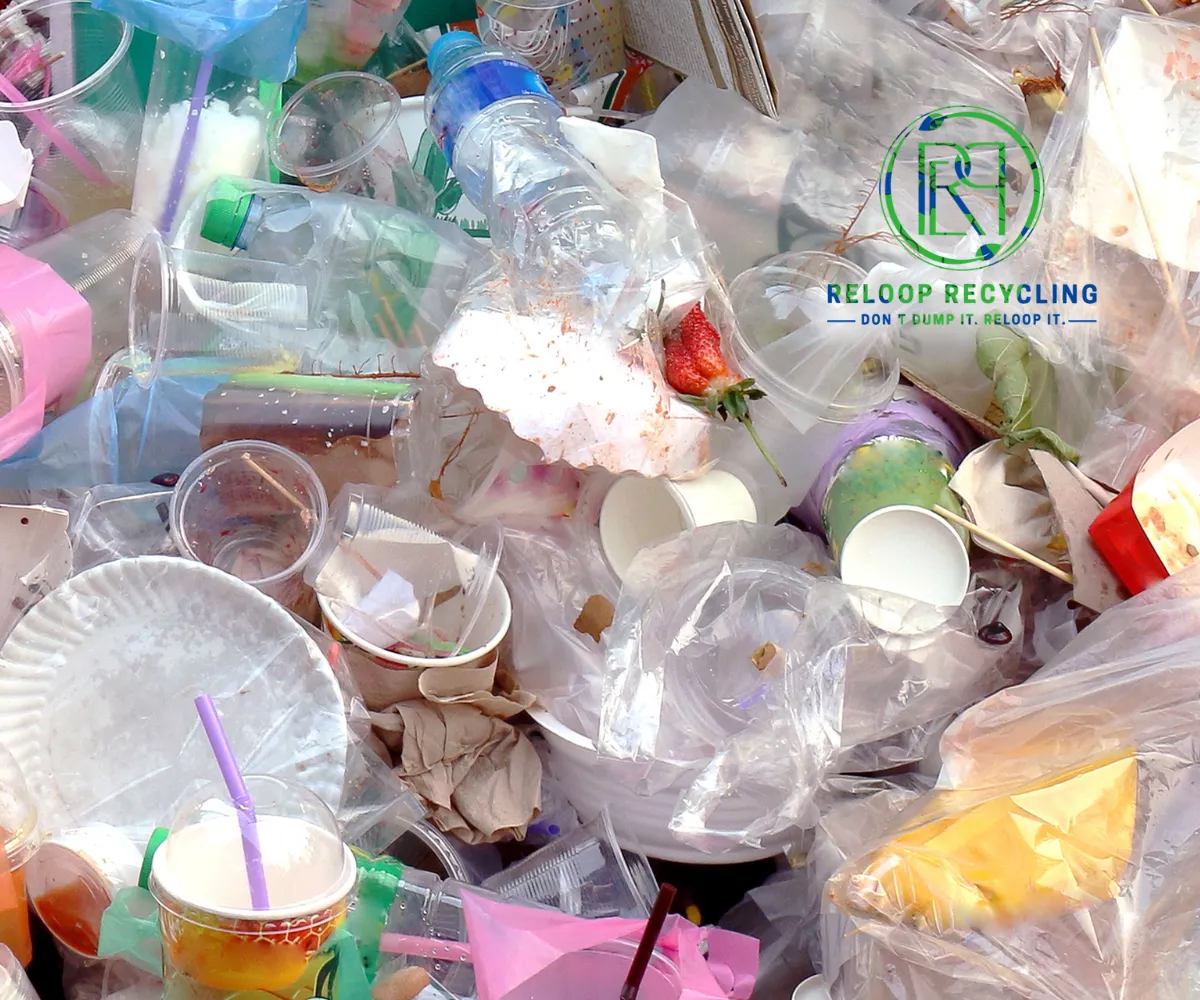
Plastic is used in almost every industry, from food packaging and retail to manufacturing, construction, electronics, healthcare, and transportation. Its low weight, durability, and versatility make it useful for countless applications. The challenge begins when plastic products are discarded without a suitable plan for reuse, recycling, or responsible disposal.
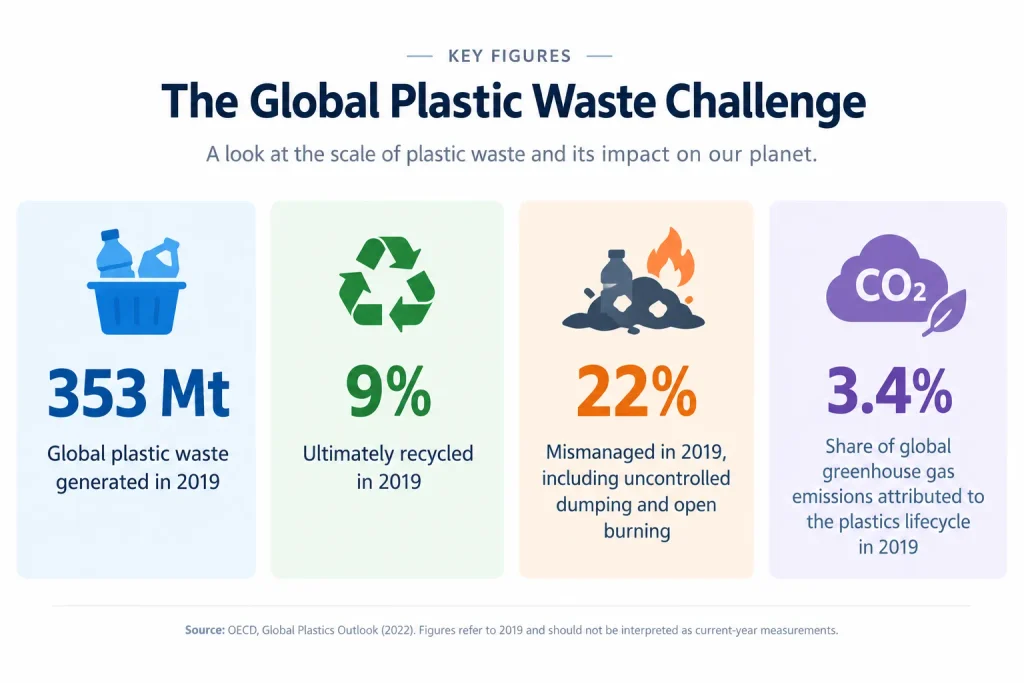
Plastic waste has become a major environmental and resource-management concern. According to the Organisation for Economic Co-operation and Development (OECD), the world generated approximately 353 million tonnes of plastic waste in 2019, and only 9% was ultimately recycled after accounting for recycling losses.
The solution is not simply to recycle more plastic. Businesses and communities also need to reduce unnecessary plastic use, improve waste segregation, design products for recovery, and create effective systems for collecting and processing discarded materials.
Plastic waste solutions include a combination of waste prevention, reuse, mechanical recycling, suitable alternative materials, improved collection systems, and responsible treatment of waste that cannot be recovered.
This article explores how these solutions work, which recycling methods are available, what businesses can do to reduce plastic waste, and how a more circular approach can help retain the value of plastic materials.
What Is Plastic Waste?
Plastic waste refers to plastic materials and products that are discarded after use, during manufacturing, or when they no longer meet their intended purpose.
It can come from households, commercial establishments, factories, construction sites, warehouses, agricultural activities, and many other sources.
Some plastic waste is relatively clean and easy to separate. For example, a batch of single-polymer manufacturing offcuts may be suitable for reprocessing. Other waste, such as food-contaminated packaging, multilayer films, mixed plastics, and products containing different materials, can be much harder to recycle.
Understanding the source and composition of plastic waste is the first step towards choosing an effective solution.
Read more – Circular Economy: Principles, Benefits & Business KPIs.
Common types of plastic waste
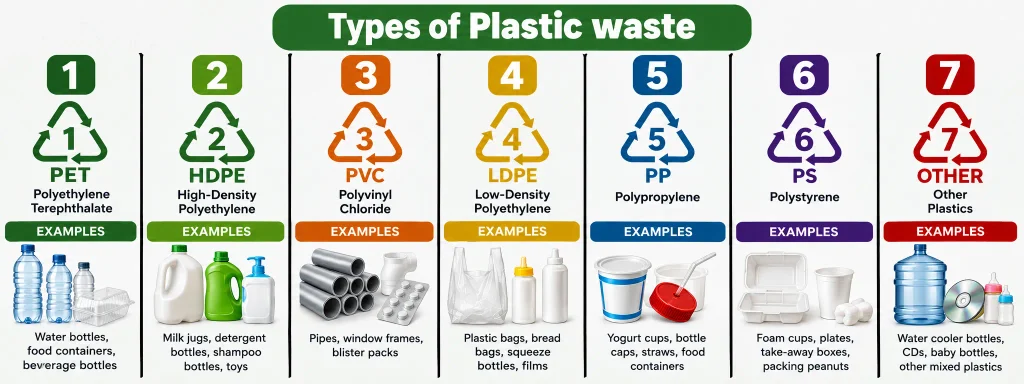
| Plastic type | Common applications | Potential management route |
|---|---|---|
| PET (polyethylene terephthalate) | Beverage bottles, food containers, polyester fibres | Sorting and recycling where suitable |
| HDPE (high-density polyethylene) | Detergent bottles, containers, pipes | Reuse or mechanical recycling where appropriate |
| PVC (polyvinyl chloride) | Pipes, cable insulation, construction products | Specialised sorting and processing |
| LDPE (low-density polyethylene) | Films, bags, flexible packaging | Film recycling where collection and processing are available |
| PP (polypropylene) | Caps, crates, tubs, automotive components | Reuse and mechanical recycling where suitable |
| PS (polystyrene) | Protective packaging, disposable food containers | Specialist recycling where viable |
| Multilayer plastics | Flexible food packaging, laminated pouches | Specialised recovery routes; often difficult to recycle mechanically |
| Mixed or contaminated plastics | Mixed packaging, production rejects | Assessment, sorting, suitable treatment, or disposal |
These are general examples, not guarantees of recyclability. Actual recovery depends on polymer composition, additives, contamination, product design, local infrastructure, and market demand.
Why Is Plastic Waste a Serious Problem?
Plastic waste is not just a littering issue. It affects how resources are used, how waste systems operate, and how materials move through the economy.
The main challenge is the gap between the large volume of plastic products entering the market and the amount that is successfully recovered at the end of their useful life.
The main challenges associated with plastic waste
Environmental pollution: Discarded plastics can accumulate on land and in aquatic environments. Larger items may fragment into smaller pieces, while some products release microplastics during use or degradation.
Loss of useful materials: Plastic products contain resources that may still have value. When suitable materials are mixed with general waste or contaminated beyond practical recovery, opportunities to reuse those resources can be lost.
Difficult recycling conditions: Not all plastics can be processed using the same equipment. Mixed polymers, labels, adhesives, food residues, pigments, and additives can complicate recycling.
Pressure on waste infrastructure: Collection and processing systems need sufficient capacity, suitable equipment, trained workers, and reliable end markets for recovered materials.
Greenhouse gas emissions: Emissions can occur during the extraction of raw materials, plastic production, conversion, transport, and end-of-life treatment. The environmental benefits of a solution depend on the full lifecycle, not simply whether a product is labelled recyclable.
The lesson is straightforward: plastic waste needs to be managed throughout its lifecycle, starting with product design and purchasing decisions and continuing through collection, recovery, and final treatment.
Read more – FMCG Waste Management for Businesses – Practical Strategies to Reduce Waste and Improve Recycling.
What Are the Most Effective Solutions for Plastic Waste?
There is no single solution that works for every type of plastic. A useful strategy combines waste prevention, reuse, recycling, product redesign, and responsible treatment.
The United Nations Environment Programme (UNEP) has highlighted three important shifts: reuse, recycling, and reorienting or diversifying products and materials. Its 2023 report estimated that a coordinated package of interventions could reduce global plastic pollution by 80% by 2040 compared with its modelled baseline. This is a scenario, not a guaranteed outcome.
Reduce unnecessary plastic use
The most direct way to manage plastic waste is to avoid creating unnecessary waste in the first place.
Businesses can review packaging specifications, purchasing practices, and product requirements to identify where plastic use can be reduced without compromising safety, quality, or product protection.
Practical examples include:
- Removing unnecessary secondary packaging.
- Optimising packaging dimensions to reduce excess material.
- Purchasing products in suitable bulk formats.
- Replacing disposable items with durable alternatives where practical.
- Improving inventory control to prevent products and packaging from becoming waste.
- Working with suppliers to redesign packaging for better recovery.
For example, a distribution warehouse may find that some products are wrapped multiple times even when fewer layers would provide adequate protection. Reviewing the packaging specification can reduce material use before recycling is even considered.
Reuse products and packaging
Reuse keeps a product in service instead of immediately turning it into waste. It can also reduce demand for replacement products and packaging.
Common examples include reusable transport crates, refillable containers, returnable pallets, durable storage boxes, and packaging take-back systems.
Reuse works best when products are durable, safe, easy to clean where necessary, and supported by a practical return or redistribution system.
A business considering reusable packaging should assess:
- How many times the item can realistically be reused.
- The transport and cleaning requirements.
- The likelihood that containers will be returned.
- The cost and environmental impact of the complete system.
- The arrangements needed when the item eventually reaches the end of its life.
Reusable products are not automatically better in every situation. Their overall benefit depends on actual reuse rates, durability, transport distances, and the materials they replace.
Improve plastic waste segregation
Segregation means separating waste according to material type and recovery requirements. It is one of the most practical steps for improving plastic recycling.
When different plastics are mixed with food waste, chemicals, paper, metals, or incompatible polymers, the resulting stream may become more difficult or expensive to process.
A commercial facility can improve segregation by:
- Providing clearly labelled collection containers.
- Separating clean production scrap from general waste.
- Keeping different polymers apart where required.
- Storing recyclable plastics in designated areas.
- Preventing avoidable contamination.
- Training staff on correct disposal procedures.
For industrial sites, segregation at the point where waste is generated can be more effective than trying to separate everything later.
Recycle suitable plastic waste
Recycling converts discarded plastic into material that can be used again. Depending on the polymer and process, the recovered material may be used in new packaging, construction products, household goods, automotive components, textiles, or other applications.
Mechanical recycling is widely used for suitable plastic streams. Other processes may be considered for specific materials that are difficult to handle through conventional mechanical methods.
However, recycling is not a substitute for reducing unnecessary plastic use. Collection does not guarantee successful recycling, and recycling does not guarantee that the recovered material can replace virgin plastic in every application.
Choose alternative materials carefully
In some cases, a product can be redesigned to use less plastic or a different material. Options may include paper-based packaging, reusable systems, or certified compostable products designed for specific disposal conditions.
The right choice depends on the product’s purpose, transport requirements, durability, hygiene needs, and local waste infrastructure.
For example, replacing plastic packaging with paper may reduce plastic use but increase material weight or create other environmental trade-offs. Compostable packaging may also require specific industrial composting conditions that are not available everywhere.
The goal should be to compare the complete system rather than assume that one material is always more sustainable than another.
How Does Plastic Recycling Work?
Plastic recycling usually involves several stages. The exact process depends on the material, the level of contamination, and the type of product being manufactured from the recovered plastic.
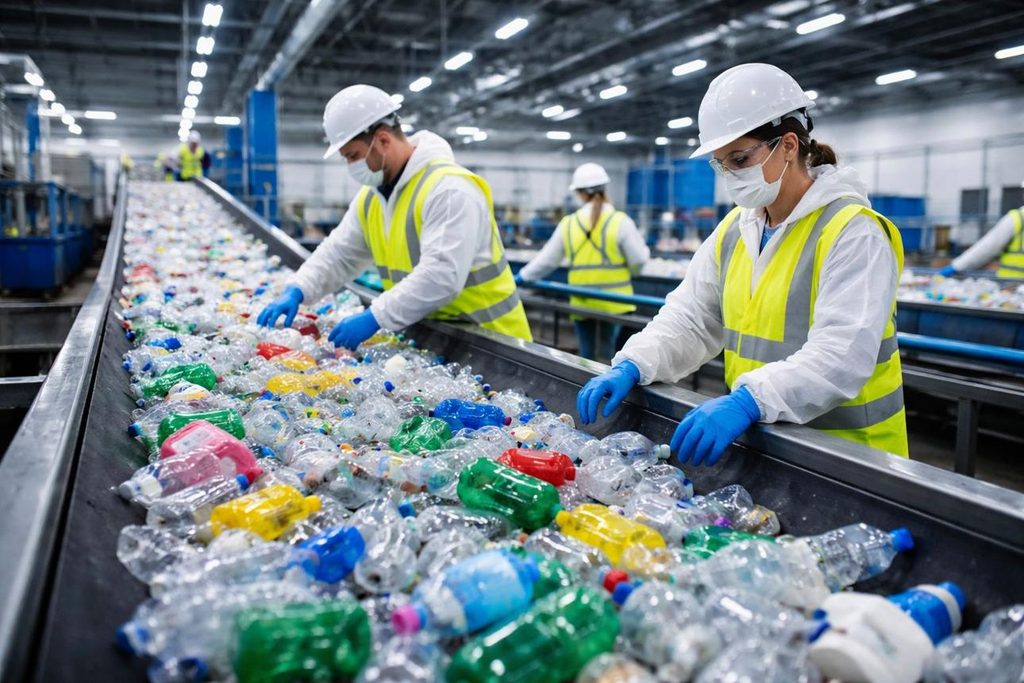
Step 1 — Collection
Plastic waste is collected from industrial, commercial, municipal, or other suitable sources.
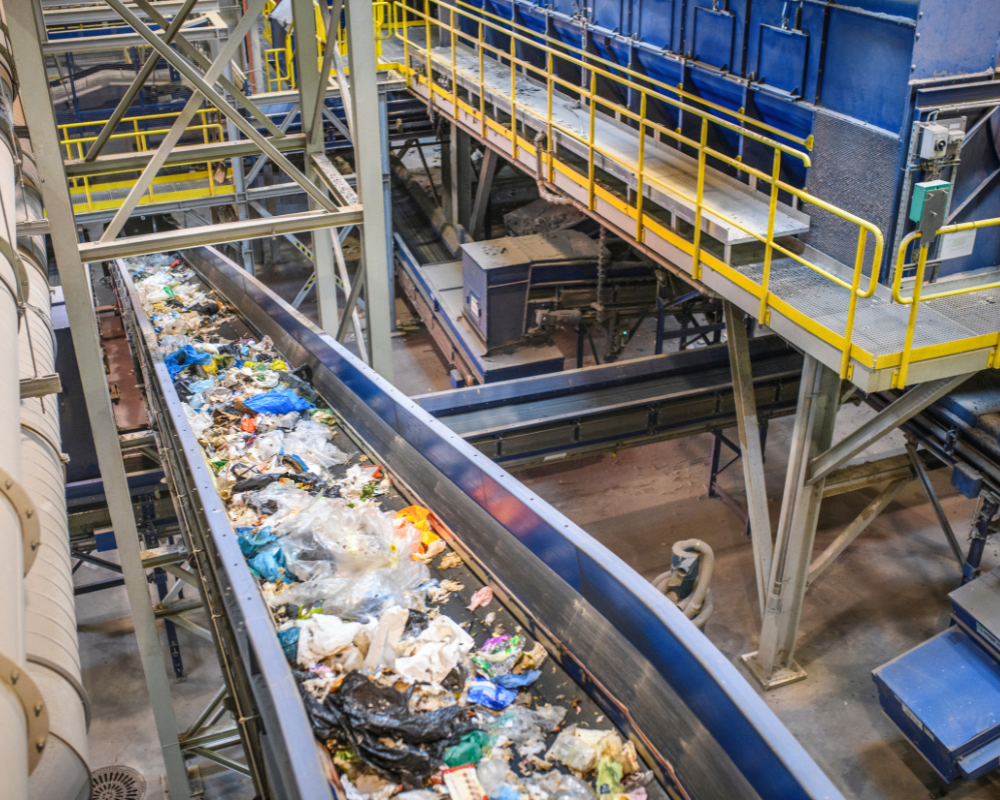
Step 2 — Sorting
Materials are separated by polymer, colour, form, and quality where required.
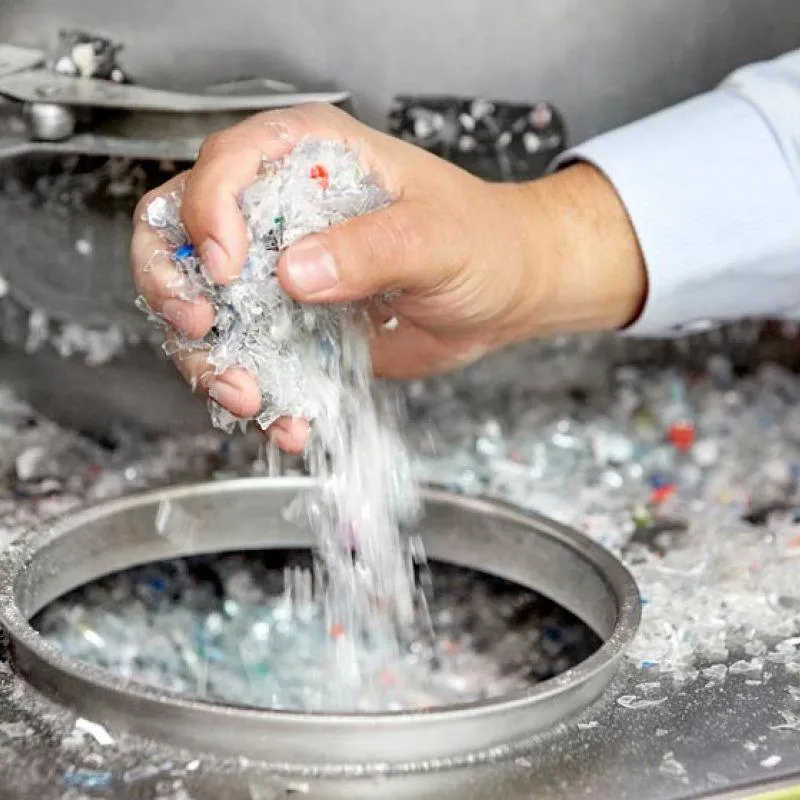
Step 3 — Preparation
Suitable plastics may be washed, shredded, and prepared for processing.
Step 4 — Reprocessing
The material is processed into flakes, pellets, or another suitable recycled feedstock, depending on the method.
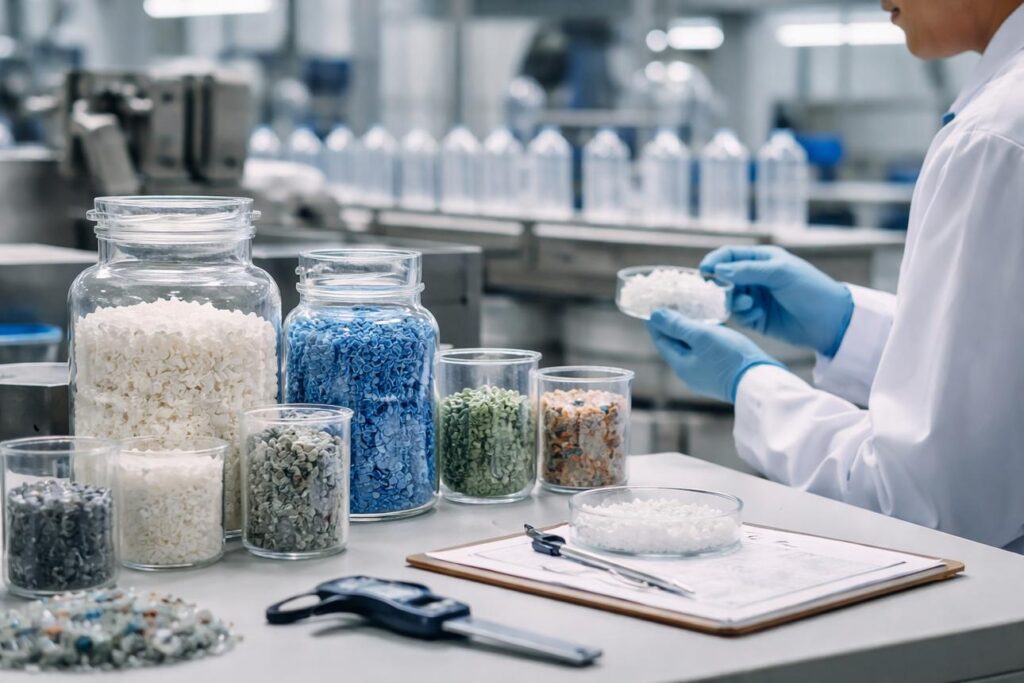
Step 5 — Quality assessment
Recovered material is checked against the quality requirements of its intended application.
Not all recycling plants use identical steps. Some plastics require specialised treatment, and certain waste streams may be unsuitable for recycling because of their composition, contamination, or processing economics.
What happens to plastic after recycling?
Recovered plastic may become a raw material for new products, but the final application depends on the quality and properties of the material.
For instance:
- Recycled PET may be used in fibres, sheets, or suitable packaging applications.
- Recycled HDPE may be used in selected containers, pipes, and non-food products.
- Recycled PP may be used in crates, household products, and industrial components.
- Recycled LDPE may be used in selected film and flexible-plastic applications.
Food-contact applications require specific safety controls and compliance with relevant regulations. Recycled plastic should not be assumed suitable for food packaging simply because it has been processed.
Types of Plastic Recycling Methods
Plastic recycling methods differ in how they process waste and the types of materials they can handle. Understanding these differences helps businesses choose appropriate recovery routes.
Mechanical recycling
Mechanical recycling processes plastic waste through physical operations such as sorting, washing, shredding, melting, and extrusion without fundamentally changing the polymer’s chemical structure.
It is commonly used for suitable, relatively well-characterised plastic waste streams.
Advantages
- Can recover usable plastic material from suitable waste.
- Established processes are available for several common polymers.
- Recovered pellets or flakes can serve as feedstock for new products.
- May reduce demand for virgin plastic when recycled material is a suitable substitute.
Limitations
- Contamination and mixed polymers can reduce material quality.
- Repeated processing may affect certain plastic properties.
- Collection, cleaning, and sorting can add significant costs.
- Some products cannot be recycled economically through mechanical methods.
Chemical recycling
Chemical recycling is a broad term for processes that change polymers into chemical feedstocks, monomers, or other substances. Depending on the technology, examples include depolymerisation and processes such as pyrolysis or gasification.
These methods may offer options for selected waste streams that are difficult to recycle mechanically. However, they are not interchangeable technologies, and their suitability varies by feedstock and intended output.
Important considerations include energy consumption, emissions, contamination tolerance, processing yields, product quality, and whether the recovered output actually replaces virgin resources.
Chemical recycling should therefore be evaluated on its technical performance and environmental impacts rather than assumed to be a universal solution for mixed or non-recyclable plastics.
Solvent-based and purification processes
Some specialised processes use solvents to separate or purify particular polymers from additives, contaminants, or mixed materials. Depending on the method, the polymer structure may remain largely intact.
These technologies can be useful for selected applications, but their performance depends on the plastic composition, chemical requirements, solvent recovery, and process economics.
Comparison of recycling methods
| Method | How it works | Potential application | Main consideration |
|---|---|---|---|
| Mechanical recycling | Physically sorts and reprocesses plastics | Suitable PET, HDPE, PP and other defined streams | Material quality and contamination |
| Depolymerisation | Breaks certain polymers into monomers or related chemical building blocks | Selected polymers such as PET or polyamides, depending on technology | Purity, yield, and energy requirements |
| Pyrolysis | Uses heat in limited or absent oxygen to produce oils, gases, and other outputs | Selected plastic-rich feedstocks | Product quality, emissions, and actual use of outputs |
| Gasification | Converts feedstock into synthesis gas under controlled conditions | Selected waste-derived feedstocks | High process requirements and overall efficiency |
| Solvent-based purification | Uses solvents to separate or purify selected polymers | Certain complex or contaminated streams | Solvent management, safety, and recovery efficiency |
No method is suitable for all plastic waste. The most appropriate option depends on the polymer, contamination, infrastructure, environmental performance, and intended end use.
What Are Sustainable Alternatives to Plastic?
Sustainable alternatives can help reduce plastic use in applications where a different material or reusable system provides the required performance with lower overall environmental impact.
The important point is to assess alternatives according to how they are produced, transported, used, and managed at the end of their useful life.
1. Reusable products
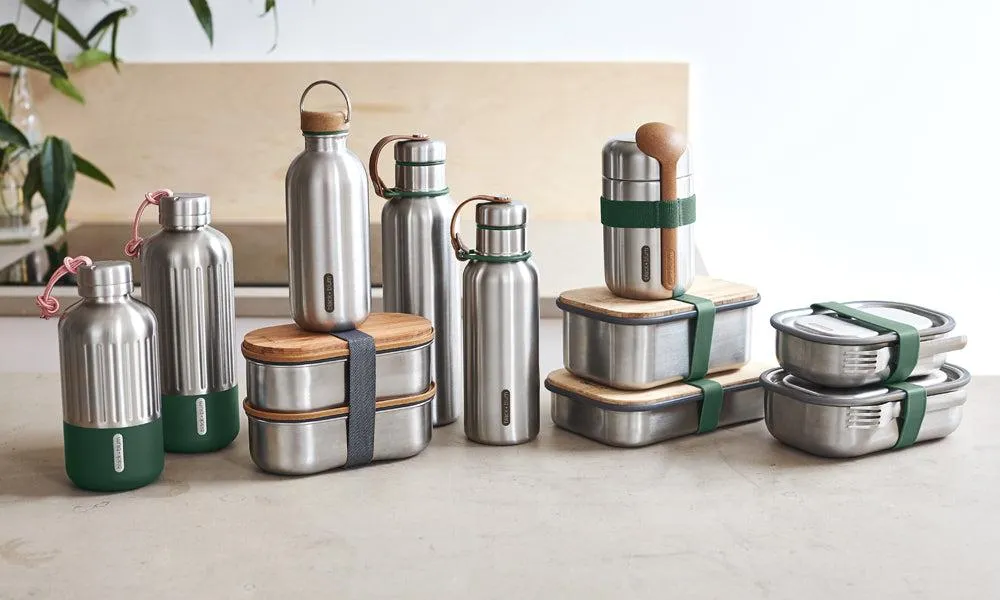
Refillable bottles, durable containers, returnable crates, and reusable transport packaging can reduce demand for disposable items when they are used enough times.
2. Paper and cardboard
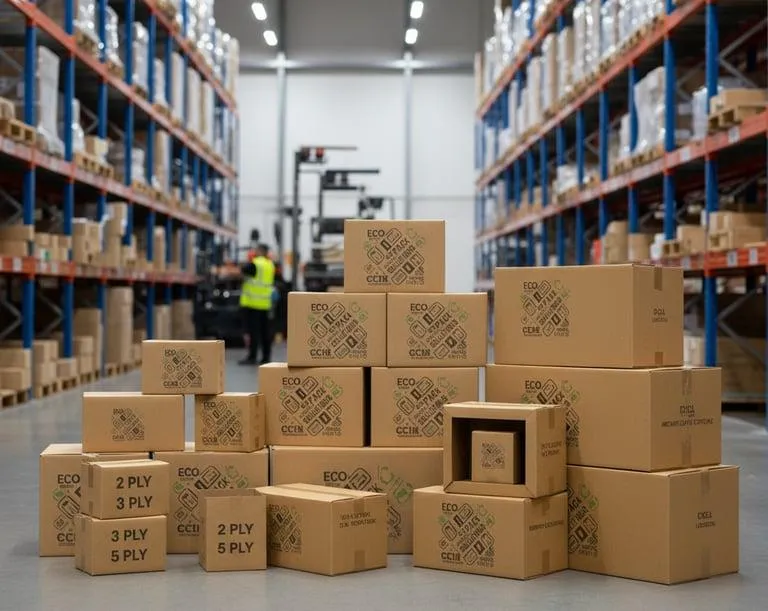
Suitable paper-based materials can replace some plastic packaging applications. Moisture resistance, product protection, coatings, and local paper-recycling capacity should be considered.
3. Moulded fibre packaging
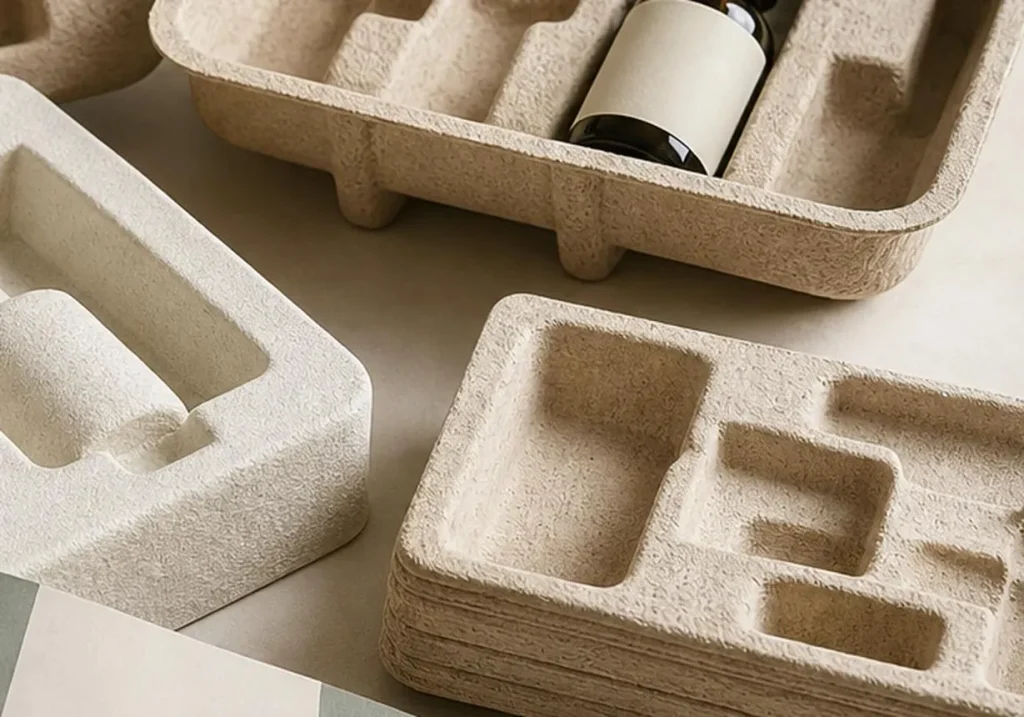
Pulp-based trays and protective inserts can be alternatives to certain foam or rigid plastic packaging applications.
4. Compostable materials
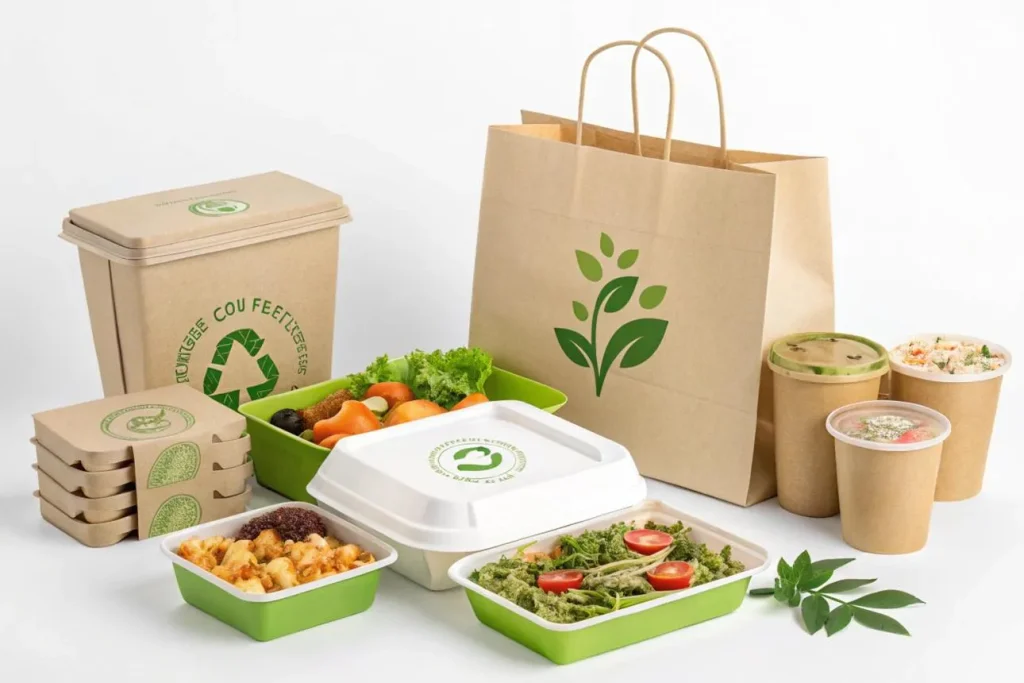
Certified compostable products may suit selected applications where appropriate composting facilities accept them. They should not be assumed to break down effectively in ordinary soil, landfills, or the natural environment.
5. Glass and other durable materials
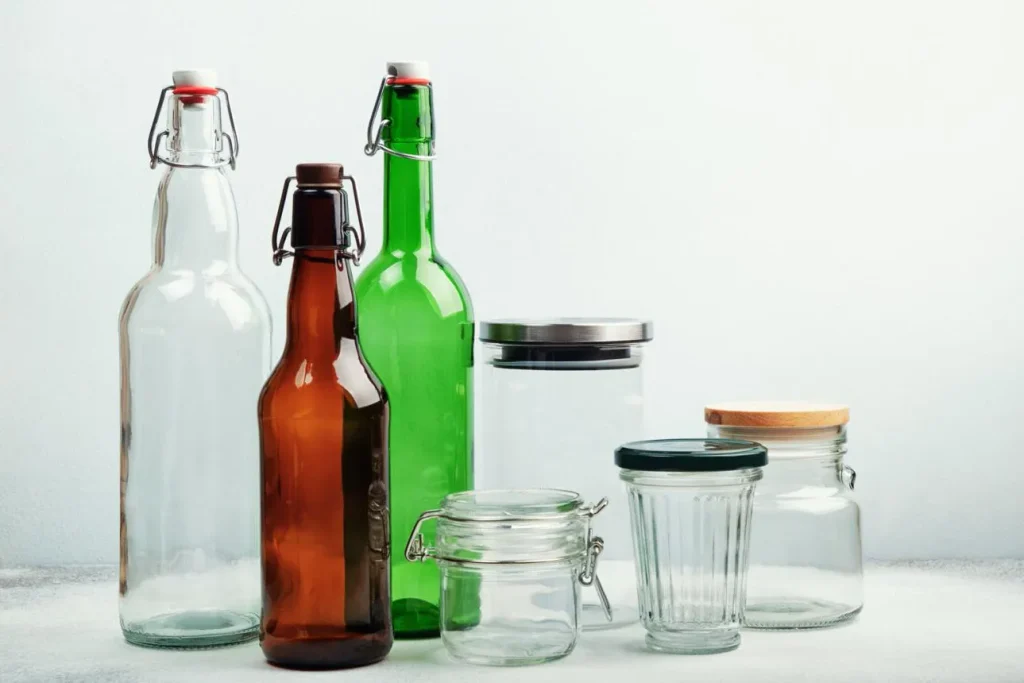
Glass or metal can replace plastic in selected applications, particularly where products can be reused. Weight, breakage, transport, cleaning, and recovery systems influence the overall environmental result.
How Can Businesses Reduce Plastic Waste?
Commercial and industrial facilities can often make meaningful improvements by addressing the sources of plastic waste before it reaches the disposal stage.
A practical programme begins with understanding the waste being generated and identifying opportunities that are technically and commercially feasible.
Conduct a plastic waste audit
Record the main types of plastic waste generated, their quantities, how frequently they arise, and where they currently go.
A useful audit may include packaging film, rigid containers, production offcuts, rejected products, plastic pallets, and mixed packaging.
Separate materials at the source
Set up designated collection points for suitable material streams. Clear labelling and staff training can help reduce contamination and improve the consistency of recyclable material.
Reduce waste in purchasing and production
Review packaging specifications, supplier practices, production rejects, and inventory management. In manufacturing, preventing offcuts and defective products can reduce waste before recycling becomes necessary.
Establish a reliable recovery route
Work with appropriate recycling and waste management providers to determine which materials can be collected, processed, reused, or recovered. Confirm relevant authorisations, documentation, and handling requirements.
Monitor results
Measure quantities generated, reused, recycled, recovered, and sent for disposal. Keep these categories separate so the business can see what happens to its waste rather than counting everything collected as recycled.
Plastic Waste Solutions for Different Industries
Plastic waste management requirements vary according to the materials used, product specifications, contamination risks, and available recovery routes.
| Industry | Common plastic waste | Possible solution |
|---|---|---|
| Manufacturing | Offcuts, rejected parts, packaging film | Segregate production scrap and reprocess suitable materials |
| Retail and distribution | Stretch wrap, crates, protective packaging | Separate clean film and reuse durable transport items |
| Food and beverage | Bottles, containers, wrapping | Apply suitable hygiene controls and segregate recyclable packaging |
| Electronics and IT | Housings, cables, packaging, mixed components | Assess components and separate plastics from other materials where feasible |
| Construction | Pipes, insulation, protective film, offcuts | Segregate by material and use appropriate specialist recovery routes |
| Automotive | Plastic components, trims, bumpers | Identify polymer types and use suitable dismantling and recycling systems |
| Agriculture | Films, containers, irrigation components | Collect and assess contamination, chemical residues, and available recycling routes |
| Textile production | Synthetic fibres, packaging, production scraps | Separate clean synthetic material from mixed or contaminated waste |
For hazardous chemical containers, heavily contaminated plastics, and products containing multiple materials, specialised handling may be required. Businesses should not mix these items with ordinary recyclable plastics without checking the relevant requirements.
What Happens to Plastic That Cannot Be Recycled?
Not all plastic waste can be recycled using available technologies. Some items are too contaminated, made from complex material combinations, or generated in quantities too small for economical recovery.
When recycling is not feasible, the material still requires responsible management.
Potential options include:
- Reuse or repurposing: Where the product is safe and suitable for continued use.
- Specialised treatment: For certain materials that require controlled processing.
- Energy recovery: Where permitted and appropriate, with suitable emissions controls.
- Controlled disposal: For residual waste that cannot be safely or practically recovered.
The appropriate route depends on the material, local regulations, facility capabilities, and environmental considerations. Open burning and uncontrolled dumping are not acceptable substitutes for proper waste management.
Businesses should also review why a material cannot be recycled. Better segregation, packaging redesign, supplier changes, or access to another recovery route may make future waste streams easier to manage.
Plastic Waste Facts and Future Outlook
The scale of plastic waste makes prevention and recovery important parts of broader resource-management strategies.
The following figures illustrate the challenge and the potential for improvement.
Three facts worth knowing
- Global plastic production in 2019, up from 234 million tonnes in 2000. Source: OECD, 2022.
- Plastic use and waste could nearly triple by 2060 under the OECD’s modelled baseline scenario. This is a projection under existing policy assumptions, not a certainty.
- UNEP’s 2023 analysis estimated that a coordinated shift towards reuse, recycling, and alternative approaches could reduce plastic pollution by 80% by 2040 compared with its baseline.
These figures show why recycling alone is unlikely to solve the plastic waste challenge. Progress will also depend on reducing unnecessary use, designing products for recovery, expanding collection systems, and creating demand for suitable recycled materials.
What could shape the future?
Better product design: Packaging and products designed for reuse, repair, and recycling can make recovery easier.
Improved collection systems: More consistent collection and sorting can help keep valuable materials out of mixed waste.
Stronger recycled-material markets: Reliable demand and quality specifications can make recycling more commercially viable.
Digital traceability: Better records can help organisations understand material flows and verify recovery outcomes.
Greater business accountability: Companies may increasingly need to document how products and packaging are managed throughout their lifecycle, according to the rules that apply to their markets.
The transition will require investment, cooperation, practical infrastructure, and realistic measurement. It will not be achieved by a single technology or material replacement.
How to Measure the Success of Plastic Waste Management
A plastic waste management programme should be evaluated by what it achieves, not simply by how much material it collects.
Businesses can establish a baseline and track progress using a small set of practical indicators.
| Performance indicator | What it tells you |
|---|---|
| Total plastic waste generated | The volume of plastic waste produced during a defined period |
| Waste prevention | Reduction in plastic waste compared with a consistent baseline |
| Reuse rate | Proportion of relevant products or packaging returned to use |
| Recycling rate | Proportion recycled, using a clearly defined calculation method |
| Material recovery yield | Usable recovered material compared with the quantity processed |
| Disposal rate | Proportion of plastic waste sent for final disposal |
| Recycled content | Share of recycled plastic used in selected products |
| Traceability | Whether material destinations and processing outcomes are documented |
A simple example
Suppose a manufacturing facility generates 20,000 kg of plastic waste in one quarter. Records show that 12,000 kg is sent for recycling, 3,000 kg is reused, and 5,000 kg requires other management routes.
The facility has documented 60% of its generated waste as sent for recycling, but that does not mean 60% has been successfully converted into new material. Processing losses and final recycling outputs must be verified separately.
This distinction helps businesses report their performance accurately and identify opportunities for improvement.
FAQs About Plastic Waste Solutions
What are the best solutions for plastic waste?
The most effective approach combines reducing unnecessary plastic use, reusing suitable products, improving segregation, recycling appropriate materials, and responsibly managing residual waste. The best solution depends on the plastic type, contamination, and available infrastructure.
How can plastic waste be reduced?
Plastic waste can be reduced by avoiding unnecessary packaging, purchasing products with less material, using durable or reusable items, improving production efficiency, and preventing avoidable product damage and waste.
What are the main methods of plastic recycling?
The main methods include mechanical recycling, chemical recycling processes such as depolymerisation and pyrolysis, and specialised purification techniques. Each has different requirements, limitations, and environmental considerations.
Which plastics are easiest to recycle?
Clean, well-separated plastic streams with known compositions and established recycling markets are generally easier to process. PET and HDPE are common examples, although actual recyclability depends on the product design, contamination, and local facilities.
Can all plastic waste be recycled?
No. Some plastics are technically difficult or commercially impractical to recycle, especially when they contain mixed polymers, complex layers, additives, or heavy contamination. Suitable waste prevention, reuse, specialised treatment, and controlled disposal may be necessary.
Are biodegradable and compostable plastics better for the environment?
Not automatically. Their environmental performance depends on the material, intended application, product lifecycle, and available disposal infrastructure. Compostable products may require specific processing conditions and should be used where an appropriate collection and treatment system exists.
How can businesses manage industrial plastic waste?
Businesses can conduct waste audits, separate plastics by type, prevent contamination, reduce avoidable packaging, reuse suitable materials, and work with appropriate recovery partners. Measuring final processing outcomes helps verify whether the programme is effective.
What is the difference between plastic waste management and plastic recycling?
Plastic waste management covers the entire process, including prevention, collection, segregation, reuse, recycling, treatment, and disposal. Recycling is one part of that broader system.
Why is plastic waste management important for the circular economy?
It helps retain materials in productive use, reduce avoidable waste, and create opportunities to recover resources. Successful circularity also depends on product design, reuse systems, demand for recycled materials, and responsible management of residual waste.
Conclusion: Moving Towards a More Circular Approach to Plastic
Plastic waste is a complex challenge, and recycling alone cannot address every part of it. Lasting progress requires better decisions at every stage, from choosing materials and designing products to reducing waste, improving collection, and recovering usable resources.
For businesses, practical improvements can start with a simple waste audit, clearer segregation, and a review of current disposal practices. Over time, these steps can help identify opportunities to prevent waste, reuse materials, and improve recovery outcomes.
Reloop Recycling supports businesses in exploring responsible waste management, recycling, and resource recovery solutions across different waste categories. By assessing each material stream and identifying suitable management routes, businesses can take a more informed approach to plastic waste.
Don’t Dump It. Reloop It.
Contact Reloop Recycling to discuss your business waste management requirements and explore practical options for plastic collection, recycling, and resource recovery.

Raju Lajwani
 Connect on LinkedIn